Mediterranean Pic’s, Part II: Travel Journals in Venice | 15-18.8.12 | Cannaregio, Jewish Ghetto…
I. Ferragosto II. Egyptian ruins III. – IV. Dark memories… V. – VI. Spirits & Ghosts
I. 15.8.12. Arrived in Venice on the highest (and most commercial) of feast days –
Ferragosto or the Feast of the Assumption – the 15th of August (which is now Italy’s biggest “bank holiday” and vacation time…) Trying to avoid the crowds – which is why we chose to stay in the North western most corner of Venice – just across a bridge from the Jewish Ghetto – where, by the way, we had two of the finest & best-priced dinners in our Italian travels – Pasta: lasagne al forno & gnocchi Bolognese at I Quattro Rusteghi. At the Kosher restaurant Gam, Gam we had exceptional Falafel, Israeli appetizers & exceptional pesto tagliatelle with cherry pomodori…
But back to the Feast of the Assumption and our wanderings around northern Venice avoiding the Rialto and staying as far from St Mark’s square as humanly possible (in a dizzyingly labyrinthine city like Venice). We just happened to take a turn where we hadn’t intended and found ourselves at the I Frari church where Tiziano’s (Titian) masterpiece,
The Assumption of the Virgin sets the chancel ablaze with its fiery red virgin already in flight, lifted to heaven as if the canvas itself were alive…
(The cloisters of the gothic cathedral Madonna dell'Orto)
Despite its omission from our travel guide in our first visit to Venice in 2009, Monteverdi’s tomb – though far more modest than Canova’s – is a humble & elegant shrine to one of western music’s first titans. The tombstone gives one the chance to brush up on Roman numerals. Claudio lived from MDMLXVII – MDCMXLIII. A bust of his goateed face sits opposite a music stand with a copy of a manuscript part-book for one of his sacred motets. (We recall – with that twinge of pain felt in the stomach & the heart – we were supposed to have lead a performance of Monteverdi’s
Vespers of 1610 with the Virginia Chorale at this year’s Virginia Arts Festival, with a baroque orchestra of old friends & colleagues largely from D.C…. Ah, the bittersweet recognitions Mnemosyne awakens in our breasts…). We digress. Monteverdi’s
Vespers premiered at St Mark’s in Venice after the aspiring artist “got the job” for which he wrote his hugely ambitious sacred masterwork. It premiered on
Ferragosto, August 15, 1613. 399 years ago to this day. It’s worth noting Monteverdi’s musical canvas of Venetian Vespers was the first great masterpiece of European choral music (a precursor to Bach’s
Mass in B minor & Beethoven’s
Missa Solemnis).
II. Needless to say, our three short days in Venice were filled with many experiences of artistic or uncanny serendipity, from happening upon a fascinating exhibit of the Egyptian ruins at
Abydos, a 5,000 year old necropolis that is among the most fascinating and least known ancient sites in the world. We had the pleasure of meeting the photographer, Paolo Renier, whose brilliant work was accompanied by video documentary commentary by archeologists from around the world. With our fractured & disjointed Italian we attempted to tell Paolo how fantastic his eye is, and how important this exhibition is. It reminds us how deep & rich is our past and how amazing the human imagination & creative impulse has always been. It might give us pause to notice how timely, how uncanny such eye-opening mind-expanding cross-cultural multi-disciplinary art exhibitions always are. Variously experienced in a medieval cathedral, an art gallery or an opera house there is no doubt that a special synergy arises when two or more dynamic forces are at work in creative harmony & imaginative counterpoint. Archeology & photography, history & philosophy, painting & sculpture, mystery & ritual, art & science all meet & engage one another in a creative discourse that could shed light on our contemporary society’s apparent inability to engage in any such positive dialogue (especially in Presidential election years).
This exhibition, at the Scuola Grande of San Giovanni Evangelista (St. John the Evangelist) was part of the church’s 750th anniversary celebration. That church is older than any extant church in the US by more years than the US has been in existence. It is a baby compared to the
Temple of Osiris, from c. 3,000 b.c.(e). It is also important to us personally, because of our deep and abiding interest and curiosity in antiquity, archeology, ancient culture & mythology (religion), art & philosophy. To cite one other example, the
Egyptian Book of the Dead is as important a work in its context as the Talmud, the Bible, the Quran or Homer is to their respective readers (to cite a quartet of Egypt’s younger nephews…)
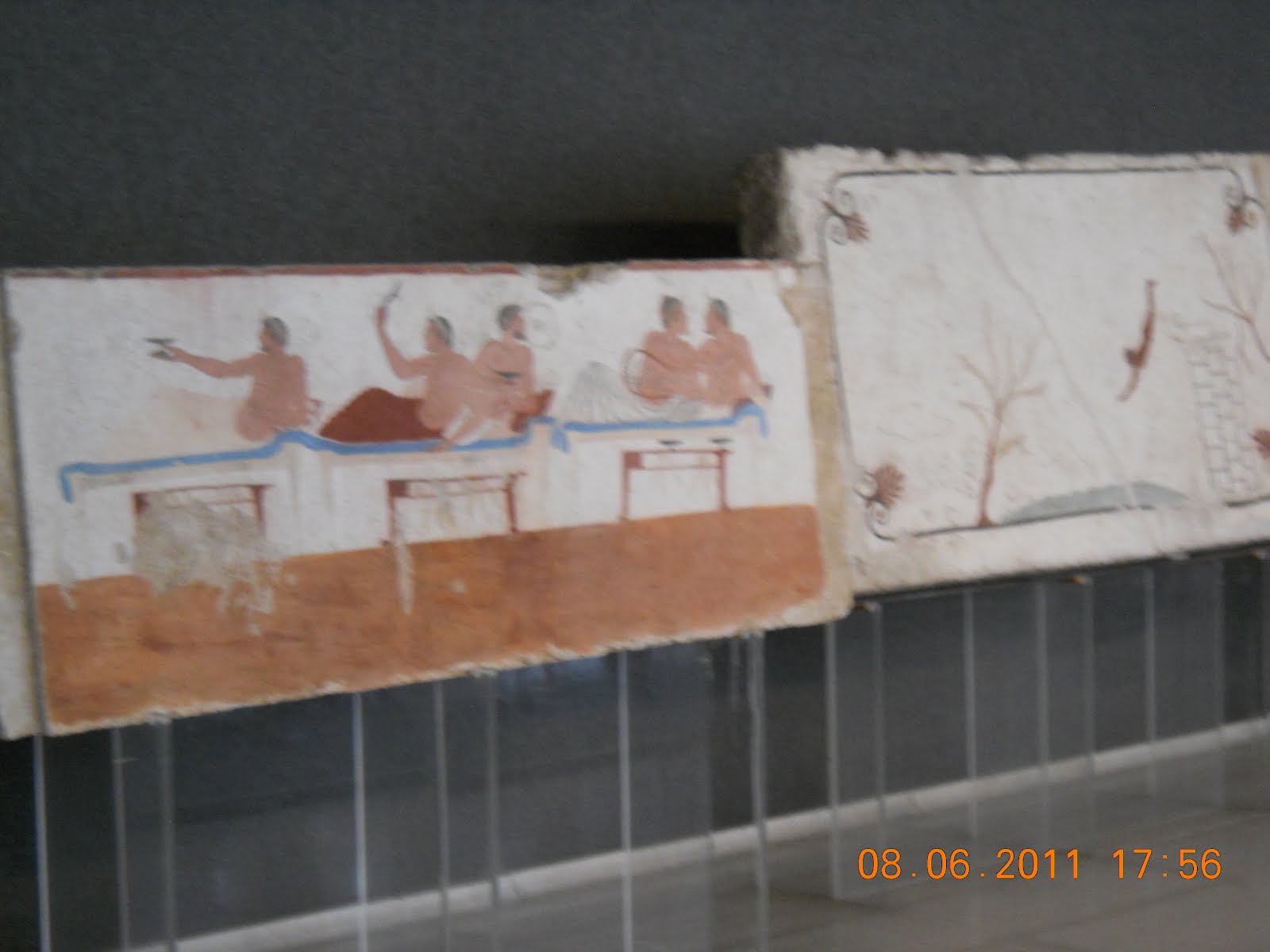
(a frieze in the courtyard of S. Giovanni Evangelista)
III. Attuned to mystery this summer, interested in the
Gothic strain of Romanticism as we prepare for Wagner’s dark & stormy ghost story,
The Flying Dutchman, our deepening interest in the esoteric & hermetic traditions continues – we are tracing the lines back and forth from the present through the 20th century to the Romantic 19th and the open-minded Renaissance, Dante’s
Inferno & the “dark ages” back to ancient Rome & Homeric Greece and beyond, across & behind… So it is no wonder we were enthralled in Rome by the tucked away
Porta Magica (the Magic Gate) full of code-signaling hieroglyphs & symbols, Egyptian gods guarding the mysteries contained within a gate only a worthy novice or initiate may decode & thereby gain entrance (this is what Tamino does in Mozart’s
Magic Flute; it is a metaphor for every Odyssey-like journey of separation, tribulation & return or renewal…) It also “just happens” that the mason Palombara was contemporary Enlightenment (during the twilight of the Renaissance, before the servant, Reason wrested complete control from his master, Intuition and heralded the so-called “Enlightenment” period…)
(The "Magic Gate" in Rome)
In addition to the hieroglyphs in the
The Temple of Osiris Revealed exhibit and those of Palombara’s
Magic Gate, we noted the
Masonic & hermetic crest at the Chiesa della Maddalena, an eye within a triangle within a circle – the geometric angles indicative of the Masonic architectural & artistic minds joining with mathematics & science, led by the essential harmony of the universe, represented in the union of such perfect symbols as the visionary “eye,” the perfect globe of the circle, the Sun & Moon and the geometric triangle, both pyramid, gem & trinity in one beautiful symmetry… Above the hieroglyphic symbol is a Latin inscription:
Sapientia. Aedificavit. Sibi. Domus. (Wisdom & Edification Dwell Here. If my Latin is not far off… Regardless, what kind of a cathedral was this Church of Mary Magdalene? Perhaps one who understood who she really was – a community open to the mysteries & the Gnostic thirst for knowledge…)
IV. Crash course through the two largest (and least densely packed)
sestieri in Venice: Cannaregio & Castello, with assistance from another new edition to our personal library (acquired in Venezia)
Venetian Ghost Stories & Legends. This engaging “alternative” walking-tour guide to
La Serenissima, the Star of the Sea ("Ave maris stella") and an enchanting poetic island empire whose cemetery is a literal
Isle of the Dead…
(bronze memorials in the Jewish Ghetto)
Having read our Shakespeare [Merchant of Venice] and studied European history, its crusades & diasporas and Inquisitions, we were already acquainted with the Jewish Ghetto. But in a case of poignant “meaningful coincidence” we had literally just made the acquaintance of a Holocaust survivor, a new friend whom we were privileged to accompany on this Mediterranean Serenade recital tour. Of all the special memories from an amazing two weeks in one of the most beautiful corners of the world, the most precious was talking to the embodiment & epitome of a true
Survivor on the final night of our trip, a valedictory evening following a deeply meaningful concert of Verismo arias and duets in the Teatro Tartini in Piran Slovenia (named after Piran’s most famous child, the Baroque violin virtuoso & composer, Giuseppe Tartini – he of the gothic Devil’s Trill Sonata…).
(The crest at the top of the proscenium of the Teatro Tartini in Piran)
At that final concert of operatic music connected to the Mediterranean, we offered Verismo-related works from
Carmen, Eugene Onegin, The Queen of Spades and other Puccini favorites. In our attempts to embody the program’s title of “Get Real: Verismo in Opera” we introduced Puccini’s Roman favorite
Tosca as a political thriller pitting a progressive/leftist artist against a draconian/conservative Baron & Henchman (following several days of often heated political discussion and debate, some generated by the engaging and provocative lectures by the political scientists & historians on board, lecturing on everything from Pirates in the Adriatic to how WWII might not have been “won” by the “good guys” to the exporting of Greek culture to the Roman empire and beyond…. For inquiring minds & opera quiz trivia buffs, we mentioned for the sake of our fellow-travelers, all of whom embarked from Rome / Civitavecchia – democrats & republicans, socialists, libertarians, tea-partiers & atheists alike – Tosca’s reference to the port of Civitavecchia, where she thinks she’s been given safe-haven by the treacherous & villainous politico, Scarpia. [NB: To be "fair & balanced" it should be noted that artists may be politically conservative and Barons may be artistically progressive. Leftists may be tyrants, artists may be bigots and conservatives sometimes have “bleeding hearts,” and keen intuitions (so-called: “feminine qualities”) & even creative genius…]
V. Where were we – ah, memory –
Mnemosyne, the Mother of the Muses, and the memorials around the Jewish Ghetto (see Shakespeare’s Merchant of Venice for the most familiar tale involving the fabled city). Having had the very recent & deeply meaningful experience of reconnecting to the horrors of the Shoah in the fronts of our minds, we set out to explore some of the darker corners of Venice. It should be noted our intention is to pay respects, to honor the dead & the mysteries & memories that haunt the past. We are not interested in “ghost stories” so much as entertainment as a window into the beyond, an archetypal (or mythological) means of metaphysical (or spiritual) connection. We had already planned to visit the
Isle of the Dead, San Michele, Venice’s cemetery in which Stravinsky & Diaghilev, Brodsky & Pound, Tiepolo & thousands upon thousands are buried. Many of our destinations are determined by artistic motivations, and honoring the resting places of the ashes of heroes, mentors & artistic forebears, kin & idols is an important consideration.
(Isola San Michele from across the lagoon)
Isola San Michele is a cemetery like no other on earth. It is charged with centuries of spirits, legends, mysteries & secrets. One of them involved a Friar at the Church of San Michele, a simple ancient church of bone-white stone. This Friar was a spiritual adept, able to discern long-buried secrets from the Devil’s dreams… (Are those eccentric mystics, Initiates, Masons, alchemists, Rosicrucians, witches, Wicca, sorcerers and mad poets to be trusted?) Anyway, this visionary priest discerned in the shifting winds before a tempest and in the changing colors of the clouds at sunset dancing on either side of a thunderstorm secrets like the hidden corners of the world (at least to most of 15th c. Europe). He apparently drew a topographically accurate map of the world without ever having left Italy… Reasonable men might credit this solely to science, logic, mathematics & other such “rational” ways of thinking… but those intuitive dreamers & visionaries, those Don Quixotes & Prosperos, the artists & thinkers & creators know that every coin has more sides than are visible…
We paid homage to
Stravinsky by listening to his masterpiece setting of the
Mass, originally written for La Scala (and last performed by yours truly in Colmar in 1996, in a memorable festival featuring Rostropovich, the Moscow Virtuosi and guest conductors M. Plasson & V. Spivakov. Our mentor & friend – and guest conductor of Opera Roanoke’s recent co-production w/ St John’s of
Amahl – Joseph Flummerfelt conducted our performance in an incense-haunted medieval cathedral, in which I was honored to make my professional European debut in this neo-classically symmetrical & architecturally structured masterpiece setting of the Mass…)
(the graves of Igor & Vera Stravinsky)
We took a close-up photo of the ballet slippers left by devotees of Diaghilev, and recalled with deep admiration our love of the Ballets Rus & the Russian muses from Pushkin & Tchaikosky, Dostoevsky & Shostakovich – and, along with the already named so many more that have spoken to us and touched us not only this summer of a special Russian communion, but across our lives…
We wrote
haiku for exiled Soviet-American poet & dissident Joseph Brodsky while sitting on the edge of Pound’s plot (a poet we don’t admire because of his fascist sympathies – like many Anglo - & Americans in the ‘30’s & ‘40’s, these often artistic or academic/intellectual political conservatives showed blatant signs of racism and specifically anti-Semitism, which led avant-garde conservatives – [oxymoronic?!] – like Pound & Eliot to apparently support fascist regimes like those in Franco’s Spain & Mussolini’s Italy…(and if we’re out of our political science/lit-crit depth, please pardon the generalizations in what is already a most discursive way of chronicling one’s travels & elucidating connections b/w cultural events, history, mythology, &tc, et alia, und so weiter…)
We also paid homage to a long-admired (if seldom listened to) avant-garde visionary and dissident activist, Luigi Nono. We shall comment on Nono’s statements of universal humanity and his opposition to fascism & racism (and therefore injustice, oppression & violence in any form) and the prominent musicians who have joined him in his oppositional confrontational fight against not only evil but also – and arguably more important – complacency, apathy, ennui & hopelessness…
VI. Our ghost trip took us to Tintoretto’s church (like the cemetery, already on our itinerary, since we missed it the last time…) the imposing gothic cathedral Madonna dell’Orto. His sprawling canvas of the
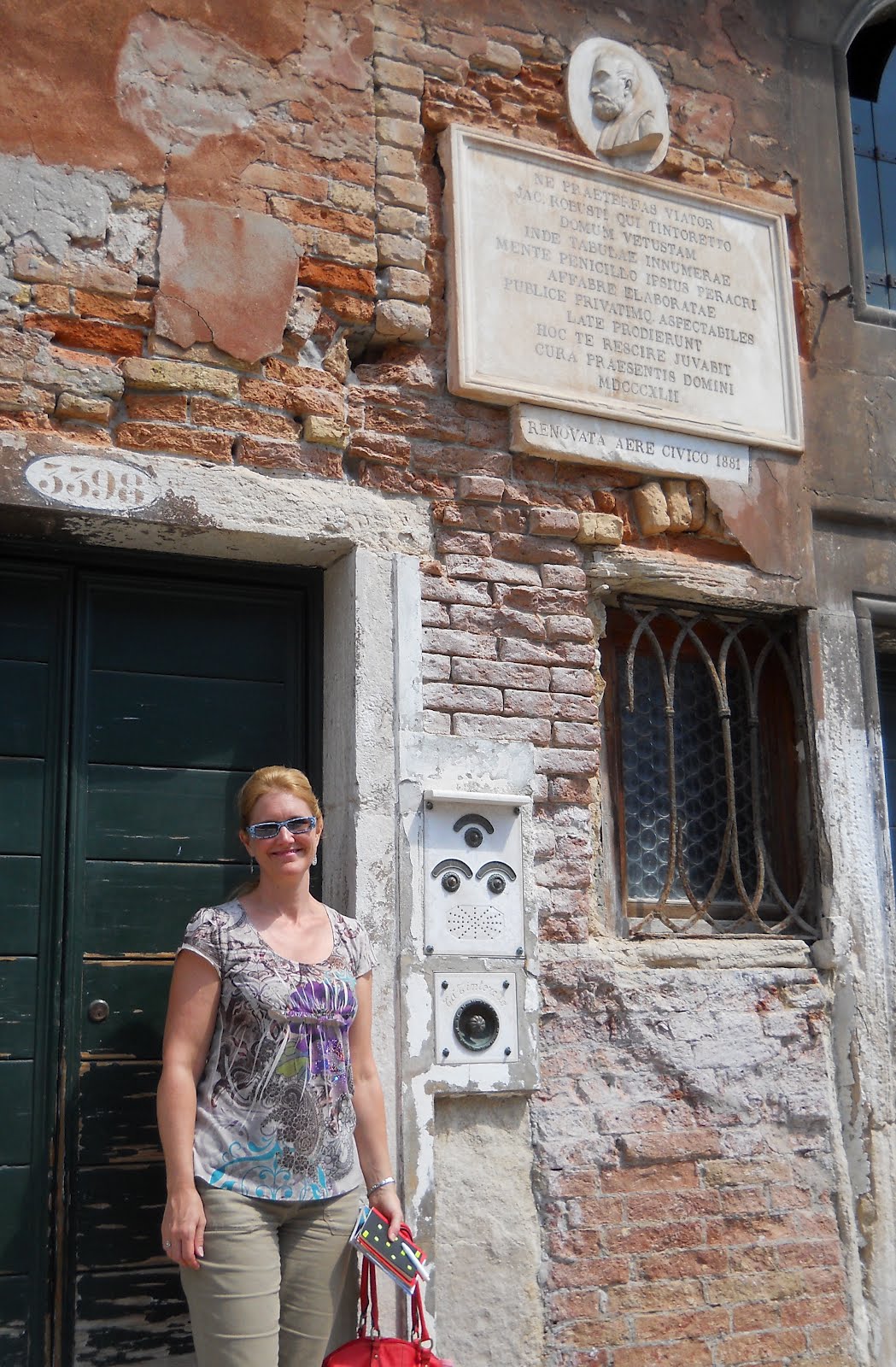
Last Judgment, rising the length of the massive chancel is one of the masterpieces of the Italian Renaissance and a staggering achievement (which took over 20 years to paint, if memory serves us…). It is a paradigm of the artistic sublime in its ability to transport the viewer through a confrontation of awesome beauty, scale & terror. It turns out he had an encounter with a witch who’d tricked his daughter and whom he caught just in time – but not quick enough for her to change into smoke and burst through a crevice in the wall – atop which Tintoretto placed a tiny sculpture of the mythic hero & strongman Hercules (the original “bouncer?”).

We returned to the Tintoretto house after we acquired the Venetian Legends book, retraced our steps and captured not only that small sculpture, but also other enigmatic sculptures, crests & reliefs in the neighborhood tied to more of these legends. With at least one foot in the ever-shifting river of “truth,” the origins of such works serve as markers & memorials – they help us remember the importance of naming the subjects, objects & beings into whose spheres we enter… This open-endedness – to ask, “Well, is this “just a legend” or “only a myth,” “or is it true?” misses the point of the symbolic (poetic, allegorical or metaphorical) meaning. Such open-endedness is characteristic of visionary artists. It allows at least one foot to be step into the creative water where there is always room for interpretation. This fundamental difference of perspective – rational & intuitive, closed & open – is at the core of the difference between the “right” and the “left,” the conservative and the progressive, the “business model” and the “artistic process.” There is a crescendo of voices proposing the distinct advantages of the latter over the former, in spheres of influence as varied as the board room & the political office, the marketing & programming boards, the talent scouts & the plucky start-up enterprises (see Ghamei, McGilchrist, Jaynes, Redfield Jamison, Whyte, et al).

(the Arsenal, with Lion statue and bust of Dante)
Another detour. Like walking around the dark
calle, sotoportege, fondamenti & campi of Venice, wondering when you will discover whether or not you’re heading in the direction you originally intended… Is there still time for
Vivaldi’s baptismal certificate & the exorcism performed on the infant genius that may have sealed his give & take relationship with the Prince of Darkness… And the mermaid Melusina & the “brick heart” hidden behind the sotoportego di Preti marking another tragic tale… the cracked-line statues of 3 runic Lions (who came to life!) at the Arsenal where a bust of Dante glares out from a wall & thus speaks Canto XXI of the
Inferno:
In the Venetians’ arsenal as boils through wintry months tenacious pitch,
To smear their unsound vessels; for the inclement time,
Sea-faring men restrains, and in that while his barque one builds anew…
PS: Memorials of
Byron & Wagner hiding in the open along the Grand Canal (Wagner’s Venetian palazzo is now the city’s Casino… Statues of Verdi & Wagner in the Giardini at the Biennale pavilions…the iconoclastic Nobel poet Giosue Carducci (new to us this journey) is represented by an imposing statue with a god-like eagle…
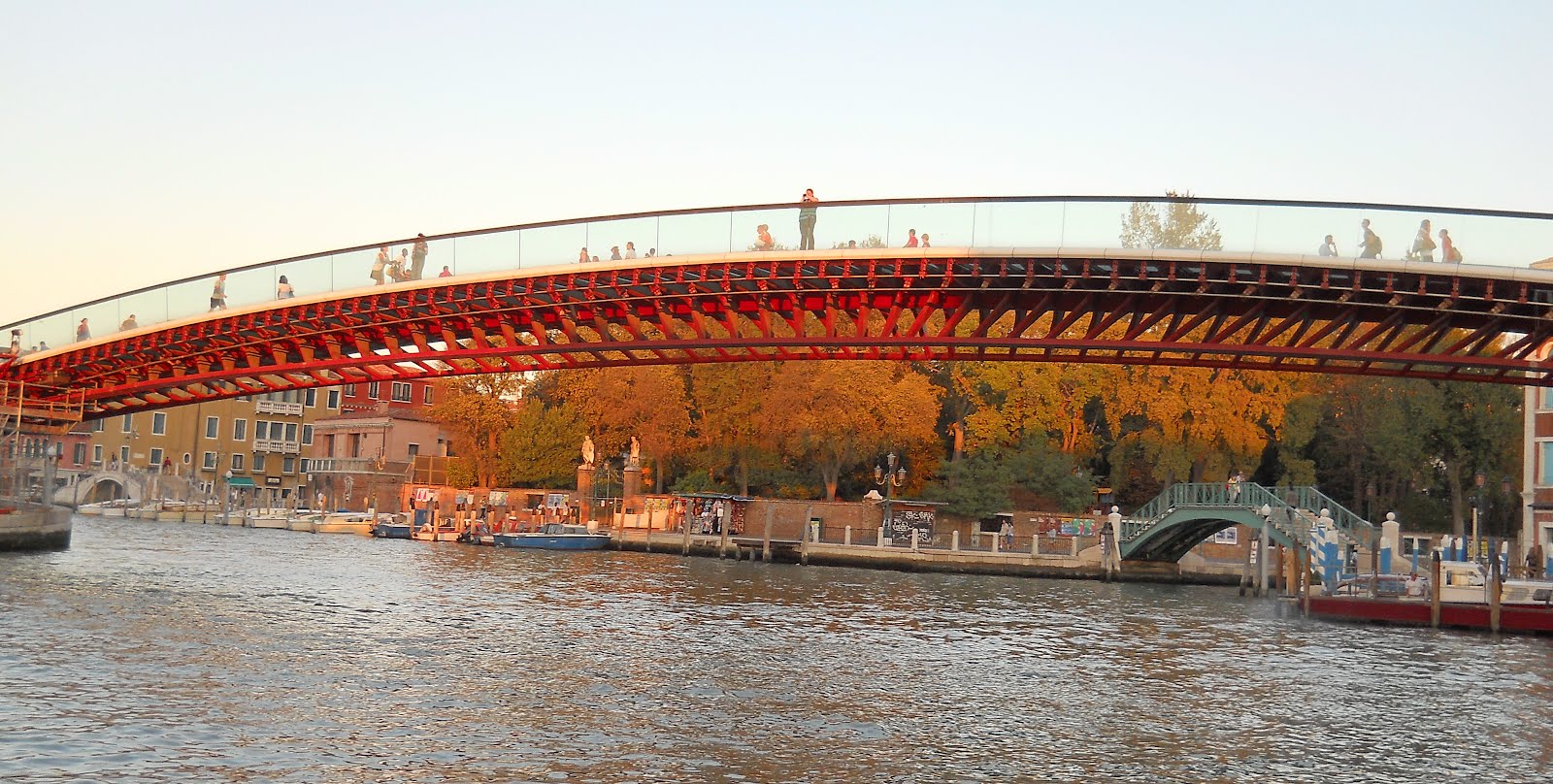
(The Grand Canal at twilight)