…incipient thoughts bat around inside my skull…
I think my head will break apart when I move from one subject to another…
there is a continual imaginative assault, which is driving me half crazy…
Reading Thomas Bernhard can be dangerous. One confronts all kinds of sickness – mental and physical, congenital, degenerate, terminal and psychosomatic. And one faces death – sudden or slow-and-painful, accidental or purposeful as suicide (an omnipresent threat). Bernhard’s through-composed stream-of-conscious style is claustrophobic and oppressive, relentless and obsessive. His vitriolic bile spews forth with vehement toxicity. His white-hot rage burns to a crisp and chills to the bone. His poison is intended for the philistines and petit bourgeois of a society corrupt to its core.
His artist-subjects’ self-loathing is everywhere apparent in darkly hilarious rants and tirades against colleagues, civil servants and most of the other members of the food chain. The following quotes are from his first novel Frost, “about” the “so-called” painter Strauch, his madness and obsessions, and the goings-on in a village filled with “morons in short sleeves” (one of his choice phrases for what “country people” represent to this disaffected child of Saturn).
(from Frost, trans. Michael Hoffmann, Vintage, 2008)
Drowning among country people is a miserable way of drowning.
Petit bourgeois businessmen fare no better.
A lawyer is an instrument of the devil…a fiendish idiot.
So-called (Bernhard’s favorite jab) artists suffer the worst fate. There is no kind of hatred quite like self-hatred. Nicht wahr, Herr Bernhard?
You know, the painter said, that art froth, that artist fornication, that general art-and-artist loathsomeness, I always found that repelling; those cloud formations of basest self-preservations topped with envy…Envy is what holds artists together, envy, pure envy, everyone envies everyone else for everything…I talked about it once before, I want to say: artists are the sons and daughters of loathsomeness, of paradisiac shamelessness, the original sons and daughters of lewdness; artists, painters, writers and musicians are the compulsive masturbators on the planet, its disgusting cramps, its peripheral puffings and swellings, its pustular secretions…I want to say: artists are the great emetic agents of the time, they were always the great, the very greatest emetics…Artists, are they not a devastating army of absurdity, of scum? The infernality of unscrupulousness is something I always meet with in the thoughts of artists…Artists are the identical twins of hypocrisy, the identical twins of low-mindedness, the identical twins of licensed exploitation, the greatest licensed exploitation of all time…Artists, as they have shown themselves to be, he said, are all dull and grandiloquent, nothing but dull and grandiloquent, nothing…
Bernhard is the Dionysus of despair whose elixir is the bile of loathing. Whose speech is colorful as peacock feathers – he has absorbed the poison and his tongue spews it forth
like maggots in space…in the shattering fat of history, in the quarterstaves of the insoluble diluvia…
No rest for the wicked made weary (or the weary made wicked) by their unresolved dissonance with the world. The painter Strauch goes to bed
not to sleep but to howl to myself in the silence of horror.
Man is an ideal hell to his fellow men.
And anathema to one so brutally honest is
the nausea of a trial by public opinion.
And sometimes Bernhard is just the ticket. Any artist who has cursed her witless critics, faced the provincialism of “popular taste” or the philistine capitulation to “commercial success” can identify with Bernhard. His inimitable voice resonates in a soulless world, corrupt by ravenous greed and numbed by a self-perpetuating system fueled by the replacing of substantive depth with surface sheen.
Everything is barbarous kitsch…Petit bourgeois sordidness…it’s too revolting.
His is like Kafka’s axe – not picking but pounding – at the frozen regions of the heart. The cacophonous volume of his vitriol threatens to drown out its pathos. The ice is so thick one forgets the affirming presence of deep water stirs underneath.
In winter, pain falls in the form of snow…Songbirds sing pain. The weak man has no law that will protect him.
Bernhard’s ostensible subject is laid bare in his debut novel, Frost. The signifier of winter’s arrival is variously described as this extraordinary frost…an iron frost…numbing frost…the ubiquitous and almost daily advancing frost… Bernhard’s pick-axe pounds relentlessly.
Frost disfigures all men…The frost eats everything up…There are many men who have been marked by frost…Frost may also signify the end of a world empire…
Life is the purest, clearest, darkest, most crystalline form of hopelessness…There is only one way to go, through the snow and ice into despair, past the adultery of reason.
What doesn’t kill us makes us stronger, eh Thomas? Bernhard is bracing, horrifying, excruciating and essential. One Bernhard is enough to counteract a legion of so-called page-turner fiction, froth & pulp for the market and masses. Lattes for the alleged literate. Bernhard’s dissenting tenor has always been a lonely voice, the irascible minority of a skeptic courageous enough to articulate the grotesque nudity underneath the emperor’s clothes. Such dissonance threatens to assault our senses. And it dares to wake us up.

Saturday, December 10, 2011


Saturday, August 20, 2011
Travel Journal: Maine
Ode on the trinity of experiences of the noble Bald Eagle
Lake St George, ME / Aug 2011
(to KF & RH & ACW, and for my father)
A lone bald eagle flew directly overhead
as we lounged this afternoon on a float
at the edge of Lake St George –
He returned for another fly-by
and we watched those eagle eyes
scanning the lake –
limning for Loons
or other prey –
beak open,
ajar though hardly slack…
We beckoned the noble bird return,
called upon the talisman of majesty, freedom
and the indomitable spirit
reserved for few such creatures
and for some of the gods
(why else would we be said to have been made in their image
if not for such awe-inspiring moments…?)
The bald eagle returned,
the third pass a totemic omen, the
charmed third-time flight a sure sign of kinship and good fortune, an
ancient sacred tripod of season & order, of lineage, and
if one believes in such things,
Hope…
Lake St George, ME / Aug 2011
(to KF & RH & ACW, and for my father)
A lone bald eagle flew directly overhead
as we lounged this afternoon on a float
at the edge of Lake St George –
He returned for another fly-by
and we watched those eagle eyes
scanning the lake –
limning for Loons
or other prey –
beak open,
ajar though hardly slack…
We beckoned the noble bird return,
called upon the talisman of majesty, freedom
and the indomitable spirit
reserved for few such creatures
and for some of the gods
(why else would we be said to have been made in their image
if not for such awe-inspiring moments…?)
The bald eagle returned,
the third pass a totemic omen, the
charmed third-time flight a sure sign of kinship and good fortune, an
ancient sacred tripod of season & order, of lineage, and
if one believes in such things,
Hope…
Saturday, July 16, 2011
Possession: artists and inspiration
Possession: artists and inspiration
or Dionysus aroused, awakened, ablaze…
(The Romantic / Mythological project, continued...)
A creative person is always most excited when something happens that he cannot explain, something mysterious or miraculous. Then he is very nervous. (Stockhausen)
[from Music and Inspiration, Jonathan Harvey. Faber, 1999]
Having read Whitman for over 20 years (more than half my life), I question if I may be possessed by part of his spirit. Since such saints manifest their spirits in countless ways, unconstrained by time or space, era or locale, it is a literal and figurative possibility.
Meaning is articulated using language. Life is experienced, processed and understood through language. And all language is potentially poetic, by its essence, creative. Ergo, “creative writing” is redundant. It can be a useful distinction for categorizing. But anything we categorize can more easily be dismissed, discarded, or merely ignored. Thus “creative writing” can be filed inferior to “factual” or “scientific” writing, which purports to be intellectually superior because “closer to the truth” of so-called “facts.”
The linguistic or philological discursion is purposeful, as I hope to show. Poetry is an excellent place to start for aspects & approaches towards “truth” in “creative writing.” Poetry can describe actual occurrences (a spider spinning a web) and simultaneously describe the metaphysical processes of the soul. For me, no poet brings together these worlds better than Whitman.
A noiseless, patient spider was perhaps the first poem I memorized. And the man who helped me learn to love poetry was my HS (sophomore year) English teacher, Mr. Vaughan. He was one of the first of many inspiring teachers & mentors I’ve been privileged to have. Do I appreciate him more now because I recognize his affirmation of intelligence, his encouragement of creative expression as being among the virtues I prize the most?
A noiseless patient spider,
I mark'd where on a little promontory it stood isolated,
Mark'd how to explore the vacant vast surrounding,
It launch'd forth filament, filament, filament out of itself,
Ever unreeling them, ever tirelessly speeding them.
And you O my soul where you stand,
Surrounded, detached, in measureless oceans of space,
Ceaselessly musing, venturing, throwing, seeking the spheres to
connect them,
Till the bridge you will need be form'd, till the ductile anchor hold,
Till the gossamer thread you fling catch somewhere, O my soul.
What a great little poem that is! Resonant with truth and open to possibility, the poem flings itself forth with the faith its filaments will “catch somewhere.” With characteristic poetic “musing” Whitman connects “the spheres” of the elusive, enigmatic soul to the natural world of the “noiseless patient spider” (and what a beautiful description, vividly imagining the natural world and awaking our senses to it). Whitman’s spider connects the earth to the “measureless oceans of space” beyond, the “once upon a time” of ancient stories and imagined galaxies of the science fiction future. Some call the beyond “heaven,” others “the heavens” and some just gesture in the direction of “out there.” The poem is always both / and. It always means on multiple levels.
Why don’t we allow the white-bearded bard to possess more of us (more of the time)? One of the all-time great Americans, great patriots, great humanitarians and one of our country’s – and the world’s! – great poets, Whitman is among the most original voices the earth has known…
Does his earthy and profane, excessive and provocative, frankly and boldly sensual, category-defying, universe-embracing, indiscriminately welcoming, positively affirming voice offend us? Scare us away? Scratch too close to the surfaces of the itchy shadows we’d rather not discuss (like faith, sexuality, government & war)?
As a volunteer nurse working for both sides during the Civil War, he attended to over 30,000 injured soldiers. Who can oppose such generous humanity? Is that not the essence, the embodiment of compassionate, agape, “brotherly” love? Who would cast a stone towards Walt Whitman?
He opens up worlds because he contains them in his all-encompassing embrace.
Such openness requires keen intelligence, strong will and patient resolve. Maintaining the tensions inherent in ambivalence, living with the dynamic irony of life’s paradoxes, and balancing the “contraries,” without which there is no progression (as the poet William Blake philosophically mused).
I love quoting Whitman’s response to protestations over his openness (past, present & future), his rebuttal of flimsy accusations of inconsistency, relative-ness & transience:
Do I contradict myself?
Very well then … I contradict myself.
I am large… I contain multitudes.
Of course, such large inspiration causes an all-consuming creative impulse to flare. Puccini wrote of the creative process approximating or even inducing illness.
When fever abates, it ends by disappearing, and without fever there is no creation; because emotional art is a kind of malady…an over-excitation of every fibre and every atom of one’s being, and so on, ad aeternum.
As I have been intimating & suggesting in my musings on Romanticism, the “romantic” notion of “emotional” art is a more universal one than our dismissive attitude towards the “romantic” type, label & symbol allows.
Last year I began reading (and naturally, quoting from) The Master and his Emissary, Iain McGilchrist’s new book subtitled “The Divided Brain and the Making of the Modern World” (Yale, 2010). This neuro-imaging doctor (Johns Hopkins), clinical psychiatrist and Oxford Fellow in Literature casts out wonderful filaments and weaves them compellingly together.
To paraphrase, the left-hemisphere generally refers to the Apollonian, rational, thinking, bourgeois “half” of the brain dialectic. The “right brain” is associated with Dionysus and creativity, the emotions and all those other subjective, affective, soul-full and heart-felt aspects that do make us wonderfully, uniquely human. It is the right brain that connects the non-linear dots to make the “self” and the “world” in which it lives. The left-brain keeps the to-do list, and almost exclusively follows the oversimplified binary “logic” called Cartesian.
One of the tics, or tricks, whereby we nowadays dismiss anything that does not fit with the left-hemisphere view of the world, is to label it ‘Romantic.’ Having done that we feel we have pulled the guts out of it. We have consigned it to a culture-bound view of the world which was relatively short-lived… and long passé, with for good measure, hints of excess, sentimentality and lack of intellectual rigor thrown in…
McGilchrist maintains Romanticism is the historical era in our Euro-American development that most nearly approaches the cultural, scientific and humanist zenith we identify with the Renaissance. I would crown the Romantic era (and the artists in its wake, like Whitman, Rilke, Mahler & Hesse, to name just a few) as our highest achievement. That is a position likely to be criticized as reactionary by the left, and dismissed as quaint or trite by the right. Generally speaking. Or metaphorically. Or both / and…McGilchrist continues
…what we dismiss as Romantic may be less limited in time and space than we imagine. In the Renaissance, the unconscious, involuntary, intuitive and implicit, that which cannot be formalized, or instilled into others by processes governed by rules, and cannot be made to obey the will, was respected and courted. All the qualities that are admired in the artist are those that come from the right hemisphere, including the skill that hides itself. They are all to be found later in Romanticism, it is true: but it will not do to bundle up half of human experience as ‘Romantic’ with an intention to dismiss it.
Aha! Well said, my dear Dr Sir! Do I thus approve because I am possessed of romantic spirits, or am I possessed by romantic spirits because I am “that kind of person” who would grant such preposterousness credence to begin? By my troth, it matters not…
Do I feel like the title character of Hesse’s Steppenwolf because I have reread him and incorporated his philosophy and poetry into my teaching and creative work? Am I “possessed” like a mad “wolf of the steppes” to even ask such questions?
Whitman approaches Steppenwolf’s realm when he writes in the 8th canto (“song,” stanza or verse) of Song of Myself:
What living & buried speech is always vibrating here, what
howls restrain’d by decorum?
In tribute to Cy Twombly (1928- July 5, 2011), mention should be made of his series of bold Bacchus canvases, vermilion red. Fire and blood. Eros and Thanatos (love & death) in one brilliant, potent color. Twombly is one of those artists unrestrained by decorum. “Engorged and overflowing with paint” is how Nicholas Cullinan describes “some of the most liquid” paintings in Twombly’s prolific 60-year career. (Cy Twombly: Cycles and Seasons. Tate, 2008)
Bacchus (Dionysus) embodies for Twombly the “ecstatic impulse.” An artist possessed by inspiration, in a rare statement about his work, the notoriously elusive and enigmatic Twombly wrote in 1957
To paint involves a certain crisis, or at least a crucial moment of sensation or release; and by crisis it should by no means be limited to a morbid state, but could just as well be one ecstatic impulse.
Harvey’s marvelous book (Music and Inspiration, with which we began) draws on the experience of modern composers as much as it does on the much-celebrated pantheon of great 19th century artists. Beethoven and Berlioz, Heine & Liszt, Whitman and Wagner all speak the “extravagant” tongues of the “Romantic” era. And as McGilchrist reminds us, the consistency of that message is too important to be routinely labeled, filed and forgotten.
The “imperious necessity” which “drives the artist to that fanatical stubbornness” (Wagner) is “not restricted to the Romantic period,” Harvey observes. After quoting from Schoenberg, Webern, Stravinsky, Debussy and Ravel, Harvey concludes:
There is a striking consensus among composers that unconscious inspiration – or instinct – is both a necessary part of the creative process and an infallible guide when compositional decisions have to be made. It is exciting, intoxicating, lucid, as seductive and sometimes as fatal as a siren, wayward, elusive, yet essential and infallible to the point of divinity.
Harvey then shares examples of how inspiration “builds itself up,” how the creative process… “ferments…by much preoccupation, engrossment with self, a being-dead to the outer world.” Mahler’s description articulates again another aspect of the Steppenwolf’s dialectic with the bourgeois “outer world” in which the creative artist never completely feels at ease or at home.
Inspiration “would flash into his mind” as the creative “eyes take fire.” Henze writes “he must come out of his shell, express his innermost self and yield up everything…”
The yielding up of everything from within is difficult at best, and as we know from every tradition we have, dangerous. Getting in touch with the “innermost self” is one of the reasons to embark not only on the artistic journey but on the individual one.
The romantic concept of the “inward journey” has been fraught with peril - like Harry Potter facing Valdemort – since it was first introduced within our species a few millennia ago through the world’s religions and foundational stories, also known as myth.
All these traditions – from the Old Testament Psalms across the Babylonian & Mesopotamian tales, from Homer to Plato to St Paul, from Dante to Don Quixote and beyond, the “hero’s journey” into and through darkness to light, life and newness is the way to salvation / enlightenment / nirvana because it is the individual’s path. Moses, Christ, Buddha, Ulysses, Aeneas, Alice, Frodo, Clark Kent, Bruce Wayne and Harry Potter all must face the dark forces, “do the right thing” and return to life in order to “share the boon” (as Joseph Campbell persuasively argues).
I tried to weave this particular strand of artistic inspiration into a little poem yesterday, in honor of the entire generation of young people – and their families – who have had the opportunity to grow up with Harry Potter. Though a late convert to the joys of this strangely familiar universe, Harry, his friends and “the order of the Phoenix” are characters right out of mythology and they are us. So brush up that mythology, mom & dad, in order to answer those questions about strange animals with wonderfully mysterious gifts. Hippogriffs are derived from the Griffins / Gryphons of mythology and reappear down the rabbit hole. Like Unicorns and wise Owls, they are everywhere equally adept at helping your child learn life’s lessons...
It’s not easy being the
chosen one, is it Harry?
Even magic cannot always
overcome the dark forces
stirring like threatening storms
surrounding us in haze
confounding us in fog…
Like Luke using the force
like comic book superheroes
battling their shadows to
earn the letter, cape and
title even though
it means donning yet
another mask. Where is
the professor to remind
us of the thousand faces
our best selves assume
to reveal their true essence
of light, love and god…
How did we get to Harry Potter? The “launched forth” filaments out of ourselves take us everywhere if we let them. Sometimes it feels like we’re possessed by a power, or force or voice or spirit. Sometimes it’s the “still, small voice” and sometimes it’s a werewolf hidden within ourselves we must face.
One of the strands I intend to muse on is the connection between American patriotism, the hero’s journey, the underdog and the superhero. Special effects might come in handy for such an enterprise. All this magic, myth and inspiration can seem a bit surreal at times.
I’ll close with one of the strongest (and strangest) voices of inspired surrealism the world has known. An artist too visionary to be dismissed as “simply” provocative or “positively” decadent. Salvador Dalí, an important anti-fascist artist (and enfant terrible, a notorious provocateur… therefore an artist whose range and depth reminds us of Whitman, Poe, Kafka, Goya, Dostoyevsky and among others, Shakespeare).
Writing in New York at the outset of World War II (like the prophet implied in the moniker “visionary” and with a sage’s wisdom where mythological references are concerned, thus reminding us of our own roots where “the city of brotherly love” and “liberty” are concerned), the “crazy Spaniard” wrote:
ARTISTS AND POETS OF AMERICA! IF YOU WISH TO RECOVER THE SACRED SOURCE OF YOUR OWN MYTHOLOGY AND YOUR OWN INSPIRATION, THE TIME HAS COME TO REUNITE YOURSELVES WITHIN THE HISTORIC BOWELS OF YOUR PHILADELPHIA, TO RING ONCE MORE THE SYMBOLIC BELL OF YOUR IMAGINATIVE INDEPENDENCE, AND, HOLDING ALOFT IN ONE HAND FRANKLIN’S LIGHTNING ROD, AND IN THE OTHER LAUTREAMONT’S UMBRELLA, TO DEFY THE STORM OF OBSCURANTISM THAT IS THREATENING YOUR COUNTRY! LOOSE THE BLINDING LIGHTNING OF YOUR ANGER AND THE AVENGING THUNDER OF YOUR PARANOIAC INSPIRATION! Only the violence and duration that is your hardened dream can resist the hideous mechanical civilization that is your enemy…
(quoted in Salvador Dalí: The Paintings. Descharnes / Néret, Taschen, 1994, 2006).
Philistine civil servants in the Ministry of Magic beware! The order of the Phoenix may again be on the rise joining the mythological realm to the romantic revolution as inspiration possesses more open-minded souls to use their superpowers to ward off evil!
or Dionysus aroused, awakened, ablaze…
(The Romantic / Mythological project, continued...)
A creative person is always most excited when something happens that he cannot explain, something mysterious or miraculous. Then he is very nervous. (Stockhausen)
[from Music and Inspiration, Jonathan Harvey. Faber, 1999]
Having read Whitman for over 20 years (more than half my life), I question if I may be possessed by part of his spirit. Since such saints manifest their spirits in countless ways, unconstrained by time or space, era or locale, it is a literal and figurative possibility.
Meaning is articulated using language. Life is experienced, processed and understood through language. And all language is potentially poetic, by its essence, creative. Ergo, “creative writing” is redundant. It can be a useful distinction for categorizing. But anything we categorize can more easily be dismissed, discarded, or merely ignored. Thus “creative writing” can be filed inferior to “factual” or “scientific” writing, which purports to be intellectually superior because “closer to the truth” of so-called “facts.”
The linguistic or philological discursion is purposeful, as I hope to show. Poetry is an excellent place to start for aspects & approaches towards “truth” in “creative writing.” Poetry can describe actual occurrences (a spider spinning a web) and simultaneously describe the metaphysical processes of the soul. For me, no poet brings together these worlds better than Whitman.
A noiseless, patient spider was perhaps the first poem I memorized. And the man who helped me learn to love poetry was my HS (sophomore year) English teacher, Mr. Vaughan. He was one of the first of many inspiring teachers & mentors I’ve been privileged to have. Do I appreciate him more now because I recognize his affirmation of intelligence, his encouragement of creative expression as being among the virtues I prize the most?
A noiseless patient spider,
I mark'd where on a little promontory it stood isolated,
Mark'd how to explore the vacant vast surrounding,
It launch'd forth filament, filament, filament out of itself,
Ever unreeling them, ever tirelessly speeding them.
And you O my soul where you stand,
Surrounded, detached, in measureless oceans of space,
Ceaselessly musing, venturing, throwing, seeking the spheres to
connect them,
Till the bridge you will need be form'd, till the ductile anchor hold,
Till the gossamer thread you fling catch somewhere, O my soul.
What a great little poem that is! Resonant with truth and open to possibility, the poem flings itself forth with the faith its filaments will “catch somewhere.” With characteristic poetic “musing” Whitman connects “the spheres” of the elusive, enigmatic soul to the natural world of the “noiseless patient spider” (and what a beautiful description, vividly imagining the natural world and awaking our senses to it). Whitman’s spider connects the earth to the “measureless oceans of space” beyond, the “once upon a time” of ancient stories and imagined galaxies of the science fiction future. Some call the beyond “heaven,” others “the heavens” and some just gesture in the direction of “out there.” The poem is always both / and. It always means on multiple levels.
Why don’t we allow the white-bearded bard to possess more of us (more of the time)? One of the all-time great Americans, great patriots, great humanitarians and one of our country’s – and the world’s! – great poets, Whitman is among the most original voices the earth has known…
Does his earthy and profane, excessive and provocative, frankly and boldly sensual, category-defying, universe-embracing, indiscriminately welcoming, positively affirming voice offend us? Scare us away? Scratch too close to the surfaces of the itchy shadows we’d rather not discuss (like faith, sexuality, government & war)?
As a volunteer nurse working for both sides during the Civil War, he attended to over 30,000 injured soldiers. Who can oppose such generous humanity? Is that not the essence, the embodiment of compassionate, agape, “brotherly” love? Who would cast a stone towards Walt Whitman?
He opens up worlds because he contains them in his all-encompassing embrace.
Such openness requires keen intelligence, strong will and patient resolve. Maintaining the tensions inherent in ambivalence, living with the dynamic irony of life’s paradoxes, and balancing the “contraries,” without which there is no progression (as the poet William Blake philosophically mused).
I love quoting Whitman’s response to protestations over his openness (past, present & future), his rebuttal of flimsy accusations of inconsistency, relative-ness & transience:
Do I contradict myself?
Very well then … I contradict myself.
I am large… I contain multitudes.
Of course, such large inspiration causes an all-consuming creative impulse to flare. Puccini wrote of the creative process approximating or even inducing illness.
When fever abates, it ends by disappearing, and without fever there is no creation; because emotional art is a kind of malady…an over-excitation of every fibre and every atom of one’s being, and so on, ad aeternum.
As I have been intimating & suggesting in my musings on Romanticism, the “romantic” notion of “emotional” art is a more universal one than our dismissive attitude towards the “romantic” type, label & symbol allows.
Last year I began reading (and naturally, quoting from) The Master and his Emissary, Iain McGilchrist’s new book subtitled “The Divided Brain and the Making of the Modern World” (Yale, 2010). This neuro-imaging doctor (Johns Hopkins), clinical psychiatrist and Oxford Fellow in Literature casts out wonderful filaments and weaves them compellingly together.
To paraphrase, the left-hemisphere generally refers to the Apollonian, rational, thinking, bourgeois “half” of the brain dialectic. The “right brain” is associated with Dionysus and creativity, the emotions and all those other subjective, affective, soul-full and heart-felt aspects that do make us wonderfully, uniquely human. It is the right brain that connects the non-linear dots to make the “self” and the “world” in which it lives. The left-brain keeps the to-do list, and almost exclusively follows the oversimplified binary “logic” called Cartesian.
One of the tics, or tricks, whereby we nowadays dismiss anything that does not fit with the left-hemisphere view of the world, is to label it ‘Romantic.’ Having done that we feel we have pulled the guts out of it. We have consigned it to a culture-bound view of the world which was relatively short-lived… and long passé, with for good measure, hints of excess, sentimentality and lack of intellectual rigor thrown in…
McGilchrist maintains Romanticism is the historical era in our Euro-American development that most nearly approaches the cultural, scientific and humanist zenith we identify with the Renaissance. I would crown the Romantic era (and the artists in its wake, like Whitman, Rilke, Mahler & Hesse, to name just a few) as our highest achievement. That is a position likely to be criticized as reactionary by the left, and dismissed as quaint or trite by the right. Generally speaking. Or metaphorically. Or both / and…McGilchrist continues
…what we dismiss as Romantic may be less limited in time and space than we imagine. In the Renaissance, the unconscious, involuntary, intuitive and implicit, that which cannot be formalized, or instilled into others by processes governed by rules, and cannot be made to obey the will, was respected and courted. All the qualities that are admired in the artist are those that come from the right hemisphere, including the skill that hides itself. They are all to be found later in Romanticism, it is true: but it will not do to bundle up half of human experience as ‘Romantic’ with an intention to dismiss it.
Aha! Well said, my dear Dr Sir! Do I thus approve because I am possessed of romantic spirits, or am I possessed by romantic spirits because I am “that kind of person” who would grant such preposterousness credence to begin? By my troth, it matters not…
Do I feel like the title character of Hesse’s Steppenwolf because I have reread him and incorporated his philosophy and poetry into my teaching and creative work? Am I “possessed” like a mad “wolf of the steppes” to even ask such questions?
Whitman approaches Steppenwolf’s realm when he writes in the 8th canto (“song,” stanza or verse) of Song of Myself:
What living & buried speech is always vibrating here, what
howls restrain’d by decorum?
In tribute to Cy Twombly (1928- July 5, 2011), mention should be made of his series of bold Bacchus canvases, vermilion red. Fire and blood. Eros and Thanatos (love & death) in one brilliant, potent color. Twombly is one of those artists unrestrained by decorum. “Engorged and overflowing with paint” is how Nicholas Cullinan describes “some of the most liquid” paintings in Twombly’s prolific 60-year career. (Cy Twombly: Cycles and Seasons. Tate, 2008)
Bacchus (Dionysus) embodies for Twombly the “ecstatic impulse.” An artist possessed by inspiration, in a rare statement about his work, the notoriously elusive and enigmatic Twombly wrote in 1957
To paint involves a certain crisis, or at least a crucial moment of sensation or release; and by crisis it should by no means be limited to a morbid state, but could just as well be one ecstatic impulse.
Harvey’s marvelous book (Music and Inspiration, with which we began) draws on the experience of modern composers as much as it does on the much-celebrated pantheon of great 19th century artists. Beethoven and Berlioz, Heine & Liszt, Whitman and Wagner all speak the “extravagant” tongues of the “Romantic” era. And as McGilchrist reminds us, the consistency of that message is too important to be routinely labeled, filed and forgotten.
The “imperious necessity” which “drives the artist to that fanatical stubbornness” (Wagner) is “not restricted to the Romantic period,” Harvey observes. After quoting from Schoenberg, Webern, Stravinsky, Debussy and Ravel, Harvey concludes:
There is a striking consensus among composers that unconscious inspiration – or instinct – is both a necessary part of the creative process and an infallible guide when compositional decisions have to be made. It is exciting, intoxicating, lucid, as seductive and sometimes as fatal as a siren, wayward, elusive, yet essential and infallible to the point of divinity.
Harvey then shares examples of how inspiration “builds itself up,” how the creative process… “ferments…by much preoccupation, engrossment with self, a being-dead to the outer world.” Mahler’s description articulates again another aspect of the Steppenwolf’s dialectic with the bourgeois “outer world” in which the creative artist never completely feels at ease or at home.
Inspiration “would flash into his mind” as the creative “eyes take fire.” Henze writes “he must come out of his shell, express his innermost self and yield up everything…”
The yielding up of everything from within is difficult at best, and as we know from every tradition we have, dangerous. Getting in touch with the “innermost self” is one of the reasons to embark not only on the artistic journey but on the individual one.
The romantic concept of the “inward journey” has been fraught with peril - like Harry Potter facing Valdemort – since it was first introduced within our species a few millennia ago through the world’s religions and foundational stories, also known as myth.
All these traditions – from the Old Testament Psalms across the Babylonian & Mesopotamian tales, from Homer to Plato to St Paul, from Dante to Don Quixote and beyond, the “hero’s journey” into and through darkness to light, life and newness is the way to salvation / enlightenment / nirvana because it is the individual’s path. Moses, Christ, Buddha, Ulysses, Aeneas, Alice, Frodo, Clark Kent, Bruce Wayne and Harry Potter all must face the dark forces, “do the right thing” and return to life in order to “share the boon” (as Joseph Campbell persuasively argues).
I tried to weave this particular strand of artistic inspiration into a little poem yesterday, in honor of the entire generation of young people – and their families – who have had the opportunity to grow up with Harry Potter. Though a late convert to the joys of this strangely familiar universe, Harry, his friends and “the order of the Phoenix” are characters right out of mythology and they are us. So brush up that mythology, mom & dad, in order to answer those questions about strange animals with wonderfully mysterious gifts. Hippogriffs are derived from the Griffins / Gryphons of mythology and reappear down the rabbit hole. Like Unicorns and wise Owls, they are everywhere equally adept at helping your child learn life’s lessons...
It’s not easy being the
chosen one, is it Harry?
Even magic cannot always
overcome the dark forces
stirring like threatening storms
surrounding us in haze
confounding us in fog…
Like Luke using the force
like comic book superheroes
battling their shadows to
earn the letter, cape and
title even though
it means donning yet
another mask. Where is
the professor to remind
us of the thousand faces
our best selves assume
to reveal their true essence
of light, love and god…
How did we get to Harry Potter? The “launched forth” filaments out of ourselves take us everywhere if we let them. Sometimes it feels like we’re possessed by a power, or force or voice or spirit. Sometimes it’s the “still, small voice” and sometimes it’s a werewolf hidden within ourselves we must face.
One of the strands I intend to muse on is the connection between American patriotism, the hero’s journey, the underdog and the superhero. Special effects might come in handy for such an enterprise. All this magic, myth and inspiration can seem a bit surreal at times.
I’ll close with one of the strongest (and strangest) voices of inspired surrealism the world has known. An artist too visionary to be dismissed as “simply” provocative or “positively” decadent. Salvador Dalí, an important anti-fascist artist (and enfant terrible, a notorious provocateur… therefore an artist whose range and depth reminds us of Whitman, Poe, Kafka, Goya, Dostoyevsky and among others, Shakespeare).
Writing in New York at the outset of World War II (like the prophet implied in the moniker “visionary” and with a sage’s wisdom where mythological references are concerned, thus reminding us of our own roots where “the city of brotherly love” and “liberty” are concerned), the “crazy Spaniard” wrote:
ARTISTS AND POETS OF AMERICA! IF YOU WISH TO RECOVER THE SACRED SOURCE OF YOUR OWN MYTHOLOGY AND YOUR OWN INSPIRATION, THE TIME HAS COME TO REUNITE YOURSELVES WITHIN THE HISTORIC BOWELS OF YOUR PHILADELPHIA, TO RING ONCE MORE THE SYMBOLIC BELL OF YOUR IMAGINATIVE INDEPENDENCE, AND, HOLDING ALOFT IN ONE HAND FRANKLIN’S LIGHTNING ROD, AND IN THE OTHER LAUTREAMONT’S UMBRELLA, TO DEFY THE STORM OF OBSCURANTISM THAT IS THREATENING YOUR COUNTRY! LOOSE THE BLINDING LIGHTNING OF YOUR ANGER AND THE AVENGING THUNDER OF YOUR PARANOIAC INSPIRATION! Only the violence and duration that is your hardened dream can resist the hideous mechanical civilization that is your enemy…
(quoted in Salvador Dalí: The Paintings. Descharnes / Néret, Taschen, 1994, 2006).
Philistine civil servants in the Ministry of Magic beware! The order of the Phoenix may again be on the rise joining the mythological realm to the romantic revolution as inspiration possesses more open-minded souls to use their superpowers to ward off evil!
Thursday, June 30, 2011
Friedrich and romantic pictures...
Caspar David Friedrich and romantic pictures in painting, poetry & music…
(notes & quotes on 19th century romanticism; see previous post...)
"You paint the way you have to in order to give, that’s life itself"
(Franz Kline, c. 1954)
"What can be learned from pictures, perhaps, is how to bring out the mysterious tale told by interlocking forms"
(James Merrill, c. 1960, in Poets on Painters).
Friedrich’s landscapes do “not so much place you as embrace you…they display you to yourself…the solitude confronts you…confronts your true arrival to the landscape, your embarkation on a Winterreise.” (Koerner: C.D.F. & The Subject of Landscape)
Erlebniskunst. Art from experience. Real-life art.
One of Friedrich’s romantic themes was to “characterize the way meaning per se is or is not present in objects…Friedrich’s landscapes will remain properly open-ended.”
Fir Trees in the Snow, 1828. (Todesjahr Schuberts. As the anniversary of an artist’s death is remembered in the German world…)

Rückenfigur. The “turned figure.” Schubert’s “Rückblick” from Winterreise. Look back.
Mark Strand says spending time with Edward Hopper’s “suburban landscapes” means being amidst “an oddness, a disturbing quiet, a sense of being in a room with a man who insists on being with us, but always with his back turned.”
Wanderer above the Sea of Fog, 1818. The quintessential romantic wanderer – loner – poet – painter – thinker – artist – rebel – outcast – exile – pilgrim – visionary landscape portrait.
 Eigentümlichkeit. “Peculiarity,” “characteristic quality” &/or “strangeness.” Literally meaning “one’s own” (eigen), “property” (Eigentum), “actually” (eigentlich) and lastly, literally “strange, eccentric” (eigentümlichkeit).
The sui generis writer Novalis embodies eigentümlichkeit as romantic virtue in his poetic musings.
The world must become romanticized. That way one finds again the original meaning...When I confer upon the commonplace a higher meaning, upon the ordinary an enigmatic experience, I romanticize it. The operation is reversed for the higher, unknown, mystical, infinite.
Do try this at home, dear reader(s). Lavish upon nature’s landscape the aesthete’s lofty praise. Deduce the mysteries of the cosmos from a moonscape and set it down, even a scrap, a fragment even…
Two Men Contemplating the Moon. Moonrise at Sea. Sea of Ice.


 Comparing the last sets of songs Schubert wrote to poems by Rellstab and Heine, is like respectively comparing “landscape with moonscape” according to Graham Johnson.
Nocturnal. Mysterious. Mystical. Supernatural. Fantastic. Fear. Shadow. Forbidden. Hidden. Holy. Dark…
Heine’s “misty visions” are poems where “beneath the blurred and atmospheric contours…is a core of German seriousness.” As if in a landscape by Friedrich.
Turning back to the romantic wanderer as loner, outsider, exile, outcast and insane, and remembering the “mad poets” Clare, Smart and Hölderlin, we Rückblich to Friedrich.
Hölderlin is one of the great masters of the poetic fragment as complete-unto-itself. An exemplar of Coleridge’s fragmentary etudes “described and exemplified.” Here is Coleridge’s “The Homeric Hexameter” in its entirety:
Strongly it bears us along in swelling and limitless billows,
Nothing before and nothing behind but the sky and the ocean.
Fragments suggest ruins. Ruins recall antiquity. Antiquity inspires the romantics through unrealized ideals, mythical & magical metamorphoses & transformations. Connecting to mythology becomes a source of not only creative stimulus, but strength and sustenance to the artist. “German seriousness” has always looked south to the Mediterranean world for the inspiration of nature, yet another fabric in this connective tapestry. Since the gods exist only in nature (technology and business rarely intrude on the ancient stages) their stories play out in the natural world and the imagined cosmos beyond it. No wonder the romantics were so in touch with nature.
Here is a typical Hölderlin fragment, called “Once and Now:”
In younger days at dawn I was filled with joy
But wept at sunset; now I am older, now
Each day begins in doubt yet every
Ending of day is calming and holy.
Which Friedrich landscape exemplifies and demonstrates the singular beauties of the fragment? The ruins of the Abby in the Oak Forest, darkly mysterious in crepuscular half-light…or the totemic energy surrounding the Rocky Gorge, the mountainous rocks metamorphosed into leaning towers of ruins…the fragments of The Churchyard landscapes, enigmatic, porous and open-ended…


Monk by the Sea, 1809-1810. Is this landscape, moonscape and seascape,
3-in-1…
 Camille Paglia reading Wordsworth notes the “romantics put the blame for modern alienation on Cartesian rationalism and Newtonian physics, which sees the world as a machine. ‘We have given our hearts away, a sordid boon’: like Faust, who sought dominance by knowledge, Western culture has sold its soul to the devil – to false idols whose reward (‘boon’) is filthy lucre. For Wordsworth, affluence brings desensitization, a deadening of the heart” (Paglia: Break, Blow, Burn).
This Sea that bares her bosom to the moon could be a Friedrich landscape. Paglia cites the image as an example of a poet’s melancholy being lifted by “ecstatic perceptions” as when “we see nature come alive.”
Paglia interweaves colorful threads of myth, psychology & history into her trenchantly provocative criticism. She concludes her discussion of Wordsworth’s sonnet, “The world is too much with us” by commenting on the poet’s romantic and pagan vision. If Wordsworth sees it “too optimistically” he still “glimpses a cosmic unity” using mythology as guide. With help from the shape-shifter Proteus he effects an Ovidian transformation. This “symbolizes nature’s constant metamorphosis” and this is exactly the subject of landscapes. Here is Wordsworth’s beloved poem.
The world is too much with us; late and soon,
Getting and spending, we lay waste our powers:
Little we see in Nature that is ours:
We have given our hearts away, a sordid boon!
This Sea that bares her bosom to the moon;
The winds that will be howling at all hours,
And are up-gathered now like sleeping flowers;
For this, for everything, we are out of tune;
It moves us not. – Great God! I’d rather be
A Pagan suckled in a creed outworn;
So might I, standing on this pleasant lea,
Have glimpses that would make me less forlorn;
Have sight of Proteus rising from the sea;
Or hear old Triton blow his wreathèd horn.
Art is possessed of mysterious power. If art were not dangerous, censorship would not exist. Not that there is anything in need of censoring here, surely! Or might there be, after a closer reading…The romantic era, in addition to being one of the most fertile and beloved periods of artistic creativity in human history, was a time of great social and political change, of foment, revolution and upheaval. Such words themselves have power to conjure images, stir the blood and engage the senses.
Paglia ends her discussion of Wordsworth’s brand of romanticism by noting his titans, Proteus and Triton operate with “elemental forces robust with the sexuality erased from the Christian Trinity.” Far from a God-hating atheist, Wordsworth’s dream “heals our estrangement” through “Pagan restoration.”
The estrangement and the burning need for restoration are at the heart of the romantic artist’s quest for unity via synthesis. The Hegelian dialectic. The Janus-faced Hero. The artist as “cosmic dancer” (Nietzsche, Campbell) leaping between worlds like a god or titan of mythology. Bringing to life images of the everyday cosmos…These are but the varied and related subjects of landscape painting, lyric poetry and romantic music…


(notes & quotes on 19th century romanticism; see previous post...)
"You paint the way you have to in order to give, that’s life itself"
(Franz Kline, c. 1954)
"What can be learned from pictures, perhaps, is how to bring out the mysterious tale told by interlocking forms"
(James Merrill, c. 1960, in Poets on Painters).
Friedrich’s landscapes do “not so much place you as embrace you…they display you to yourself…the solitude confronts you…confronts your true arrival to the landscape, your embarkation on a Winterreise.” (Koerner: C.D.F. & The Subject of Landscape)
Erlebniskunst. Art from experience. Real-life art.
One of Friedrich’s romantic themes was to “characterize the way meaning per se is or is not present in objects…Friedrich’s landscapes will remain properly open-ended.”
Fir Trees in the Snow, 1828. (Todesjahr Schuberts. As the anniversary of an artist’s death is remembered in the German world…)

Rückenfigur. The “turned figure.” Schubert’s “Rückblick” from Winterreise. Look back.
Mark Strand says spending time with Edward Hopper’s “suburban landscapes” means being amidst “an oddness, a disturbing quiet, a sense of being in a room with a man who insists on being with us, but always with his back turned.”
Wanderer above the Sea of Fog, 1818. The quintessential romantic wanderer – loner – poet – painter – thinker – artist – rebel – outcast – exile – pilgrim – visionary landscape portrait.
 Eigentümlichkeit. “Peculiarity,” “characteristic quality” &/or “strangeness.” Literally meaning “one’s own” (eigen), “property” (Eigentum), “actually” (eigentlich) and lastly, literally “strange, eccentric” (eigentümlichkeit).
The sui generis writer Novalis embodies eigentümlichkeit as romantic virtue in his poetic musings.
The world must become romanticized. That way one finds again the original meaning...When I confer upon the commonplace a higher meaning, upon the ordinary an enigmatic experience, I romanticize it. The operation is reversed for the higher, unknown, mystical, infinite.
Do try this at home, dear reader(s). Lavish upon nature’s landscape the aesthete’s lofty praise. Deduce the mysteries of the cosmos from a moonscape and set it down, even a scrap, a fragment even…
Two Men Contemplating the Moon. Moonrise at Sea. Sea of Ice.


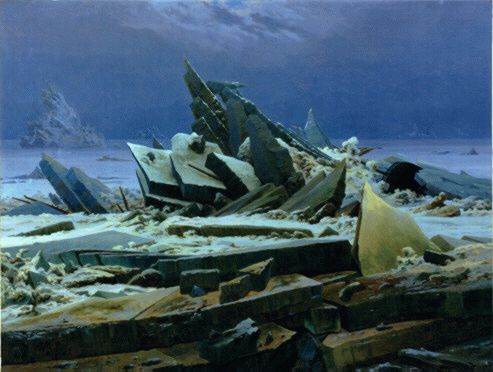 Comparing the last sets of songs Schubert wrote to poems by Rellstab and Heine, is like respectively comparing “landscape with moonscape” according to Graham Johnson.
Nocturnal. Mysterious. Mystical. Supernatural. Fantastic. Fear. Shadow. Forbidden. Hidden. Holy. Dark…
Heine’s “misty visions” are poems where “beneath the blurred and atmospheric contours…is a core of German seriousness.” As if in a landscape by Friedrich.
Turning back to the romantic wanderer as loner, outsider, exile, outcast and insane, and remembering the “mad poets” Clare, Smart and Hölderlin, we Rückblich to Friedrich.
Hölderlin is one of the great masters of the poetic fragment as complete-unto-itself. An exemplar of Coleridge’s fragmentary etudes “described and exemplified.” Here is Coleridge’s “The Homeric Hexameter” in its entirety:
Strongly it bears us along in swelling and limitless billows,
Nothing before and nothing behind but the sky and the ocean.
Fragments suggest ruins. Ruins recall antiquity. Antiquity inspires the romantics through unrealized ideals, mythical & magical metamorphoses & transformations. Connecting to mythology becomes a source of not only creative stimulus, but strength and sustenance to the artist. “German seriousness” has always looked south to the Mediterranean world for the inspiration of nature, yet another fabric in this connective tapestry. Since the gods exist only in nature (technology and business rarely intrude on the ancient stages) their stories play out in the natural world and the imagined cosmos beyond it. No wonder the romantics were so in touch with nature.
Here is a typical Hölderlin fragment, called “Once and Now:”
In younger days at dawn I was filled with joy
But wept at sunset; now I am older, now
Each day begins in doubt yet every
Ending of day is calming and holy.
Which Friedrich landscape exemplifies and demonstrates the singular beauties of the fragment? The ruins of the Abby in the Oak Forest, darkly mysterious in crepuscular half-light…or the totemic energy surrounding the Rocky Gorge, the mountainous rocks metamorphosed into leaning towers of ruins…the fragments of The Churchyard landscapes, enigmatic, porous and open-ended…


Monk by the Sea, 1809-1810. Is this landscape, moonscape and seascape,
3-in-1…
 Camille Paglia reading Wordsworth notes the “romantics put the blame for modern alienation on Cartesian rationalism and Newtonian physics, which sees the world as a machine. ‘We have given our hearts away, a sordid boon’: like Faust, who sought dominance by knowledge, Western culture has sold its soul to the devil – to false idols whose reward (‘boon’) is filthy lucre. For Wordsworth, affluence brings desensitization, a deadening of the heart” (Paglia: Break, Blow, Burn).
This Sea that bares her bosom to the moon could be a Friedrich landscape. Paglia cites the image as an example of a poet’s melancholy being lifted by “ecstatic perceptions” as when “we see nature come alive.”
Paglia interweaves colorful threads of myth, psychology & history into her trenchantly provocative criticism. She concludes her discussion of Wordsworth’s sonnet, “The world is too much with us” by commenting on the poet’s romantic and pagan vision. If Wordsworth sees it “too optimistically” he still “glimpses a cosmic unity” using mythology as guide. With help from the shape-shifter Proteus he effects an Ovidian transformation. This “symbolizes nature’s constant metamorphosis” and this is exactly the subject of landscapes. Here is Wordsworth’s beloved poem.
The world is too much with us; late and soon,
Getting and spending, we lay waste our powers:
Little we see in Nature that is ours:
We have given our hearts away, a sordid boon!
This Sea that bares her bosom to the moon;
The winds that will be howling at all hours,
And are up-gathered now like sleeping flowers;
For this, for everything, we are out of tune;
It moves us not. – Great God! I’d rather be
A Pagan suckled in a creed outworn;
So might I, standing on this pleasant lea,
Have glimpses that would make me less forlorn;
Have sight of Proteus rising from the sea;
Or hear old Triton blow his wreathèd horn.
Art is possessed of mysterious power. If art were not dangerous, censorship would not exist. Not that there is anything in need of censoring here, surely! Or might there be, after a closer reading…The romantic era, in addition to being one of the most fertile and beloved periods of artistic creativity in human history, was a time of great social and political change, of foment, revolution and upheaval. Such words themselves have power to conjure images, stir the blood and engage the senses.
Paglia ends her discussion of Wordsworth’s brand of romanticism by noting his titans, Proteus and Triton operate with “elemental forces robust with the sexuality erased from the Christian Trinity.” Far from a God-hating atheist, Wordsworth’s dream “heals our estrangement” through “Pagan restoration.”
The estrangement and the burning need for restoration are at the heart of the romantic artist’s quest for unity via synthesis. The Hegelian dialectic. The Janus-faced Hero. The artist as “cosmic dancer” (Nietzsche, Campbell) leaping between worlds like a god or titan of mythology. Bringing to life images of the everyday cosmos…These are but the varied and related subjects of landscape painting, lyric poetry and romantic music…


Wednesday, June 29, 2011
Heine and Hesse and the Romantic Dialectic
I picked up Hesse’s Steppenwolf after returning from a visit to the Spoleto Festival USA last month. First read it 15 years ago while a young professional at the Spoleto Festival USA.
Returning to W & L next week as a guest lecturer on 19th century Romanticism. Particularly of the German variety.
Recalling Hegel’s dialectic. Thesis – Antithesis – Synthesis. Synthesis: ay, there’s the rub.
Steppenwolf embodies several manifestations of the dialectic. Apollonian / Dionysian, Bourgeois / Bohemian, Reason / Emotion, Society / Artist, Harry Haller / Steppenwolf.
Artists may be first among those caught between two ages, who are outside of all security and simple acquiescence…those whose fate it is to live the whole riddle of human destiny heightened to the pitch of a personal torture...
That personal torture is cause and effect, symptom and illness, sickness and cure. Hesse carries the Romantic torch, articulating the dialectic between the artist and society. His enterprise is romantic on multiple levels. As the surrounding quotes should show, his mission is the artist’s realization of his many-flowered self. Soul flowers opening to the world new sights and smells via the creative imagination. The artist as the ideal human being; servant to a higher, greater power; bringer of the soul’s boon; bearer of the cups of the fullness of life. Lofty, yes. And a necessary essential to the well-being of the individual and the world.
He reminds us of some hallmarks of true heroes: the engaged will, relentless striving and uncompromising standards… there are always a few such people who demand the utmost of life and yet cannot come to terms with its stupidity and crudeness!
But such aspirations sometimes produce bittersweet fruit. Here is Karl Schumann on Schubert’s & Müller’s Winterreise, one of the seminal works embodying the tortured Romantic soul:
The young man with the incurable wound in his heart, since Lord Byron an altogether commonplace cliché figure of Romanticism, is taken bitterly seriously by Schubert and pushed to the point of no return. It borders on the pathological; the wandering youth of Winterreise, … driven out by overwhelming emotional frustration into the hostile, frostbound winter landscape, … is the magnified symbol of the Romantic man at the mercy of his feelings, the homeless stranger on the cold earth, the fugitive from the world, excluded from human fellowship by the overwhelming, self-destructive strength of his emotions.
Schumann’s essay is entitled “Twenty-Four Stages on a Journey into the Void.” The Romantic Dialectic has so many dimensions. Soul flowers. As Steppenwolf learns…
You have a dimension too many…whoever wants music instead of noise, joy instead of pleasure, soul instead of gold, creative work instead of business, passion instead of foolery, finds no home in this trivial world of ours…
With such Byronic heroic striving comes the tension and ambivalence of contingency, mortality, humanity. Thank the Romantics for the return of humor as antidote to such torture.
The Janus-faced Heroes like Beethoven and Goethe look back to the Classical world of ancient Greece. Beethoven Hero. Goethezeit. For inspiration in the fragments and relics of antiquity. For models and symbols in mythology. For the transformative power of the imagination. The heady & spiritual intoxication of the awakening of the aesthetic impulse. Dionysus (Bacchus), among other things god of the theater, symbolizes the tragicomic dialectic in poetry and drama. Ironic?
One of the highlights of Spoleto USA this year was a chamber music recital of Shostakovich’s great piano quintet. Amazing piece of music. Haunting. Poignant. Droll. Sad. Vivacious. Mordantly witty. Searing.
Shostakovich, taking up the mantle of ironic musical humor from Mahler, Haydn and Mozart, journeys into the modern void (via Stalin’s Russia) and laughs as often as he despairs.
In Steppenwolf, he would be genius enough to attempt the quest…instead of discoursing pitifully…at every difficulty encountered.
(Is the pitiful discourse one of the reasons we mistrust Odysseus / Ulysses as a hero?)
Shostakovich Hero? Steppenwolf Hero? Don Quixote Hero?
And whoever wants more and has got it in him – the heroic and the beautiful and the reverence for the great poets or for the saints – is a fool and a Don Quixote.
Steppenwolf’s elusive muse and oracle and mythic guide, Hermine, as another sign of her eminent qualifications, loves Cervantes. The Artist / Society (or Bohemian / Bourgeois) tension manifests like the “hundred integuments” of the onion that is the human being.
The war against death…is always a beautiful, noble and wonderful and glorious thing, and so, it follows is the war against war. But it is always hopeless and quixotic too.
Quixotic. Adventurous. Idealist. Utopian. Chivalrous. Noble. Courageous. Foolish. Independent. Fearless. Impossible. Poetic. Visionary. Mad.
Hesse links those last two attributes and indentifies one of the risks of the artist’s self-realization. To break through the illusion of the unity of the personality and perceive that the self is made up of a bundle of selves…say so and at once the majority puts them under lock and key…
The visionary &/or mad poet – composer – artist is another Romantic trope that is Janus-faced and ever present. In a world dominated by philistines, Heine is a truly literate and insightful critic. And visionary, mad poet himself. Here he is on Liszt after an 1841 Paris concert:
The electric effect of a demonic nature on a crowd that is all pressed together, the infectious power of ecstasy, and perhaps the magnetism of the music itself, this spiritualistic illness of the age, which vibrates in almost all of us—I have never encountered these phenomena so distinctly and so frighteningly as in the concert by Liszt.
Heine’s wit is of the mordant, ironic variety. I recall advice from the best director I know, Tim Carroll on the seriousness of playing humor with a reminder the word “sarcasm” comes from the Greek sarcasmos, “to tear the flesh off…”
That illuminates a description like “cutting” or “biting” wit. It opens a window into its appearance in art, from the ancient Greek tragedies through Shakespeare and Cervantes to Blake and Coleridge, Goethe and Heine, Mahler and Shostakovich.
Ovid’s Metamorphosis is one of the seminal sources of our mythological heritage. These versions of creation stories and other mythological figures & heroes involve transformation. And like all mythology, mean more figuratively than literally. The literal interpretation is intended to open a window into the imagination. They are artistic creations of immense psychological, emotional and spiritual depth. And the Romantic era awakened a connection to these powerful sources we are in danger of losing.
The opera director Luc Bondy, writing on Handel’s Hercules (itself based partly on Ovid) could be a classics scholar or mythology guru like Joseph Campbell, rather than the avant-garde Regietheater maverick he is considered to be.
There are some versions that are undeniably more interesting than others…fundamentally, we are more sensitive to these more perilous dramas. They represent a real rupture, and to my mind, embody a modernity that has never been surpassed since the ancient Greeks. This is because the Greeks invented a form and for that form they had myths at their disposal. Today we have the forms but we no longer have the myths.
But we have Handel and Heine and Hesse. We have music and poetry and drama. We have mythology at no more than one remove. Heroes and Titans. Prometheus unbound and defiant.
The pianist and art song scholar Graham Johnson describes one aspect of Heine’s persona using Promethean terms in an essay about Schumann’s great song-cycle Dichterliebe.
Heine is the poet of change and insurrection, both personal and political. He appears here to us exactly as he appeared to Schumann…the incarnation of the misunderstood poet, sinned against by the stupidity and insensitivity of others, smiling ironically at his small-minded critics, and suffering betrayal with a stoicism born of a greatness of soul that effortlessly shames the pettiness of everyone around him.
We should all live so large! (As Johnson goes on to illustrate, Heine's life did not equal his artistic achievement). Let us wrap up this romantic and rambling musing with more music. Steppenwolf (in his bourgeois incarnation as Harry Haller) meets a gypsy-like musician who may or may not be an incarnation of Mozart. And in that enigmatic detail is one of many reasons I love Hesse so! This is great advice for any apprentice or artist in any discipline in any era.
Music does not depend on being right, on having good taste and education…[It depends] on making music as well and as much as possible and with all the intensity of which one is capable.
Mozart appears near the close of Hesse’s novel, and using Handel as an example reminds us why music is not a luxury but a necessity.
Let the sense of this ritardando touch you. Do you hear the basses? They stride like gods. And let this inspiration of old Handel penetrate your restless heart and give it peace. Just listen…listen without either pathos or mockery…Listen well. You have need of it.
Returning to W & L next week as a guest lecturer on 19th century Romanticism. Particularly of the German variety.
Recalling Hegel’s dialectic. Thesis – Antithesis – Synthesis. Synthesis: ay, there’s the rub.
Steppenwolf embodies several manifestations of the dialectic. Apollonian / Dionysian, Bourgeois / Bohemian, Reason / Emotion, Society / Artist, Harry Haller / Steppenwolf.
Artists may be first among those caught between two ages, who are outside of all security and simple acquiescence…those whose fate it is to live the whole riddle of human destiny heightened to the pitch of a personal torture...
That personal torture is cause and effect, symptom and illness, sickness and cure. Hesse carries the Romantic torch, articulating the dialectic between the artist and society. His enterprise is romantic on multiple levels. As the surrounding quotes should show, his mission is the artist’s realization of his many-flowered self. Soul flowers opening to the world new sights and smells via the creative imagination. The artist as the ideal human being; servant to a higher, greater power; bringer of the soul’s boon; bearer of the cups of the fullness of life. Lofty, yes. And a necessary essential to the well-being of the individual and the world.
He reminds us of some hallmarks of true heroes: the engaged will, relentless striving and uncompromising standards… there are always a few such people who demand the utmost of life and yet cannot come to terms with its stupidity and crudeness!
But such aspirations sometimes produce bittersweet fruit. Here is Karl Schumann on Schubert’s & Müller’s Winterreise, one of the seminal works embodying the tortured Romantic soul:
The young man with the incurable wound in his heart, since Lord Byron an altogether commonplace cliché figure of Romanticism, is taken bitterly seriously by Schubert and pushed to the point of no return. It borders on the pathological; the wandering youth of Winterreise, … driven out by overwhelming emotional frustration into the hostile, frostbound winter landscape, … is the magnified symbol of the Romantic man at the mercy of his feelings, the homeless stranger on the cold earth, the fugitive from the world, excluded from human fellowship by the overwhelming, self-destructive strength of his emotions.
Schumann’s essay is entitled “Twenty-Four Stages on a Journey into the Void.” The Romantic Dialectic has so many dimensions. Soul flowers. As Steppenwolf learns…
You have a dimension too many…whoever wants music instead of noise, joy instead of pleasure, soul instead of gold, creative work instead of business, passion instead of foolery, finds no home in this trivial world of ours…
With such Byronic heroic striving comes the tension and ambivalence of contingency, mortality, humanity. Thank the Romantics for the return of humor as antidote to such torture.
The Janus-faced Heroes like Beethoven and Goethe look back to the Classical world of ancient Greece. Beethoven Hero. Goethezeit. For inspiration in the fragments and relics of antiquity. For models and symbols in mythology. For the transformative power of the imagination. The heady & spiritual intoxication of the awakening of the aesthetic impulse. Dionysus (Bacchus), among other things god of the theater, symbolizes the tragicomic dialectic in poetry and drama. Ironic?
One of the highlights of Spoleto USA this year was a chamber music recital of Shostakovich’s great piano quintet. Amazing piece of music. Haunting. Poignant. Droll. Sad. Vivacious. Mordantly witty. Searing.
Shostakovich, taking up the mantle of ironic musical humor from Mahler, Haydn and Mozart, journeys into the modern void (via Stalin’s Russia) and laughs as often as he despairs.
In Steppenwolf, he would be genius enough to attempt the quest…instead of discoursing pitifully…at every difficulty encountered.
(Is the pitiful discourse one of the reasons we mistrust Odysseus / Ulysses as a hero?)
Shostakovich Hero? Steppenwolf Hero? Don Quixote Hero?
And whoever wants more and has got it in him – the heroic and the beautiful and the reverence for the great poets or for the saints – is a fool and a Don Quixote.
Steppenwolf’s elusive muse and oracle and mythic guide, Hermine, as another sign of her eminent qualifications, loves Cervantes. The Artist / Society (or Bohemian / Bourgeois) tension manifests like the “hundred integuments” of the onion that is the human being.
The war against death…is always a beautiful, noble and wonderful and glorious thing, and so, it follows is the war against war. But it is always hopeless and quixotic too.
Quixotic. Adventurous. Idealist. Utopian. Chivalrous. Noble. Courageous. Foolish. Independent. Fearless. Impossible. Poetic. Visionary. Mad.
Hesse links those last two attributes and indentifies one of the risks of the artist’s self-realization. To break through the illusion of the unity of the personality and perceive that the self is made up of a bundle of selves…say so and at once the majority puts them under lock and key…
The visionary &/or mad poet – composer – artist is another Romantic trope that is Janus-faced and ever present. In a world dominated by philistines, Heine is a truly literate and insightful critic. And visionary, mad poet himself. Here he is on Liszt after an 1841 Paris concert:
The electric effect of a demonic nature on a crowd that is all pressed together, the infectious power of ecstasy, and perhaps the magnetism of the music itself, this spiritualistic illness of the age, which vibrates in almost all of us—I have never encountered these phenomena so distinctly and so frighteningly as in the concert by Liszt.
Heine’s wit is of the mordant, ironic variety. I recall advice from the best director I know, Tim Carroll on the seriousness of playing humor with a reminder the word “sarcasm” comes from the Greek sarcasmos, “to tear the flesh off…”
That illuminates a description like “cutting” or “biting” wit. It opens a window into its appearance in art, from the ancient Greek tragedies through Shakespeare and Cervantes to Blake and Coleridge, Goethe and Heine, Mahler and Shostakovich.
Ovid’s Metamorphosis is one of the seminal sources of our mythological heritage. These versions of creation stories and other mythological figures & heroes involve transformation. And like all mythology, mean more figuratively than literally. The literal interpretation is intended to open a window into the imagination. They are artistic creations of immense psychological, emotional and spiritual depth. And the Romantic era awakened a connection to these powerful sources we are in danger of losing.
The opera director Luc Bondy, writing on Handel’s Hercules (itself based partly on Ovid) could be a classics scholar or mythology guru like Joseph Campbell, rather than the avant-garde Regietheater maverick he is considered to be.
There are some versions that are undeniably more interesting than others…fundamentally, we are more sensitive to these more perilous dramas. They represent a real rupture, and to my mind, embody a modernity that has never been surpassed since the ancient Greeks. This is because the Greeks invented a form and for that form they had myths at their disposal. Today we have the forms but we no longer have the myths.
But we have Handel and Heine and Hesse. We have music and poetry and drama. We have mythology at no more than one remove. Heroes and Titans. Prometheus unbound and defiant.
The pianist and art song scholar Graham Johnson describes one aspect of Heine’s persona using Promethean terms in an essay about Schumann’s great song-cycle Dichterliebe.
Heine is the poet of change and insurrection, both personal and political. He appears here to us exactly as he appeared to Schumann…the incarnation of the misunderstood poet, sinned against by the stupidity and insensitivity of others, smiling ironically at his small-minded critics, and suffering betrayal with a stoicism born of a greatness of soul that effortlessly shames the pettiness of everyone around him.
We should all live so large! (As Johnson goes on to illustrate, Heine's life did not equal his artistic achievement). Let us wrap up this romantic and rambling musing with more music. Steppenwolf (in his bourgeois incarnation as Harry Haller) meets a gypsy-like musician who may or may not be an incarnation of Mozart. And in that enigmatic detail is one of many reasons I love Hesse so! This is great advice for any apprentice or artist in any discipline in any era.
Music does not depend on being right, on having good taste and education…[It depends] on making music as well and as much as possible and with all the intensity of which one is capable.
Mozart appears near the close of Hesse’s novel, and using Handel as an example reminds us why music is not a luxury but a necessity.
Let the sense of this ritardando touch you. Do you hear the basses? They stride like gods. And let this inspiration of old Handel penetrate your restless heart and give it peace. Just listen…listen without either pathos or mockery…Listen well. You have need of it.
Saturday, June 18, 2011
The Eolian Harp...
Coleridge is genius. His poetic describing of the world is so pitch-perfect the leaps of his imagination appear obvious. I love the following self-defense statement about his overzealous loyalty to colleagues known only to him through their work.
"The controversies, occasioned by my unfeigned zeal..." could be applied by the writer of this sentence to any number of occasions, conversations, relationships, et al. Passion hath a habit of spilling over...
Coleridge invented a word, esemplastic, by literally joining two Greek fragments. Some of his epigrammatic poems are subtitled, "Described and Exemplified" and thus the form is content and the title is both. "The Homeric Hexameter" and the "Ovidian Elegaic Metre" are two examples to which we may return. Esemplastic means "to shape into one." We continue thus with another varied and episodic, cryptic and enigmatic, esemplastic musing.
The previous rambling mentioned the association between romantic inspiration (afflatus) and the Aeolian harp. Coleridge's ode to Orpheus, the origins of music and artistic romanticism is entitled "The Eolian Harp," and is full of "honey-dropping flowers" of images like
The stilly murmur of the distant Sea
Tells us of silence
The liquid alliteration of the diction mimics water, but even more striking to me is the odd little adjective "stilly." I take such delightful diminutives to be emblematic of Colerdge's original genius. The eloquent, poetic turn of phrase is another distinction that marks his genius original. Like "the desultory breeze caress'd." Pure music!
As in the witty phrase "occasioned by my unfeigned zeal" above, ignorance of the subject matter does not bar one from admission into this lyrically imaginative world. Another entry point is the vivid fancy of "twilight Elfins" from some accessible (not nearly so "long ago & far away" as we accustom ourselves) "Fairy-land."
The "honey-dropping flowers" that may or may not be Homer's - and Tennyson's - "Lotus-Eaters" are products of one of "many idle flitting phantasies." As if the poet tasted of his own artistic opiate to dull the pain of the cruel, unfeeling, profit-driven world (the Lotus-Eaters are lulled by forgetfulness and numbed to desire by partaking of the Lotus flower). The poem of Sir Alfred the Lord opens with the orphic invocation,
There is sweet music here that softer falls
Than petals from blown roses on the grass
Still the romantic ideal that is idealism itself shines a light through the dreamy balm of unbearable lightness. To return to Coleridge's musician waxing utopian,
Methinks, it should have been impossible
Not to love all things in a world so fill'd;
Where the breeze warbles, and the mute still air
Is Music slumbering on her instrument.
Coleridge's most famous visionary image is the 50-line fragment, "Kubla Khan" The poem's subtitle is "Or, A Vision In A Dream" and in a preface the author describes its origin.
The Author continued for about three hours in a profound sleep, at least of the external senses, during which time he has the most vivid confidence, that he could not have composed less than two to three hundred lines; if that indeed could be called composition in which all the images rose up before him as things, with a parallel production of correspondent expressions, without any sensation or conscious effort. On awaking he appeared to himself to have a distinct recollection of the whole...
And that is one of the most lively descriptions of the creative process vis-a-vis its "flash" or "divine spark" of inspiration, the imagination "set fire" or "ablaze" by inspiration. The creative person "possessed" or "driven" by inspiration. Whether "as if in a dream" or vision literal or figurative.
My imagination has been subject to vision-like experiences as a veil falls between myself and the outer world (to paraphrase Hesse's Steppenwolf, to which we shall return).
I have been inspired by dreams and by the waking hours leading up to sleep, especially the periods from dusk (the gloaming) through night to early morning. A series of "Nocturne" poems are the humble, half-chiseled results.
I. The light keeps changing across this landscape
so the mountains never appear the same twice.
People are happier here, I've heard it said.
With so much beauty always around -
the magic of living in a valley is to always
be surrounded by peaks -
how can at least some peace not be found?
Nowhere near as visionary as Samuel Taylor C, I hope my intention to honor our esteemed saint and patron of the imagination might absolve me of some of my presumption and rudeness. As Uncle Walt reminds us, our "many faults and derelictions" exist inextricably with our virtues, visions and aspirations.
One of my aspirations is bound up in sharing both Whitman's voice with a world in desperate need of such affirming creativity, and pitching my own voice to such unabashed, inclusive and all-embracing joy.
Whitman is our most operatic bard, and not merely because he was an opera-lover himself. I cannot imagine how anyone could spend enough time with Whitman to become acquainted with the original tone of his voice, and not recognize how indiscriminate is his compassion, how unconditional his love. His is a portrait of the artist as a saint.
Another attempt at articulating more of my visions and dreams resulted in approximating a 7th Nocturne:
The birth of 1,000 suns
the opening of one to the many
one opening to the manifestation
of 1,000 flowers of the soul
Entering the place
reserved for madmen
poets and musicians
writers and other bohemians
leaving preconceptions like baggage
selves, practical concerns all left
before the threshold
Entering the world
beyond the world
behind the facade
beneath the ground
already below the surface
above the limits
Such poetic thinking is also indebted to Hesse's Steppenwolf, who observes "man is the narrow and perilous bridge between nature and spirit."
Precarious bridges span many gulfs in our figurative worlds. The linked shores appear as twins or polar opposites. Castor and Pollux. Cain and Abel. Yin and Yang. Scylla and Charybdis. Tweedle-Dee and -Dum. Apollo and Dionysus.
I came to Coleridge yesterday through Wordsworth. Particularly the philosopher Don Cupitt's noticing the "promising lines of thinking being opened up" in / by Wordsworth's romanticism. The opening-up of thinking and the piquing of curiosity. The opening of the senses via the the body's relationship to life and experience. The opening of the heart to the range and depth of human emotion, the authentic experience of being touched, feelings that resonate and reverberate deeper than imagined. And the ultimate opening up of the soul to the "other." To transcendence. Nirvana. Bliss. Salvation.
Or simply, Life.
The romantics were possessed of vision and imagination our contemporary, post-modern world needs in order to correct a long-developing imbalance. One of the correctives is poetry. Its excessiveness. Its inventiveness. Its openness. Its life-affirming embrace.
One of the other delightful benefits of poetry is its regenerative capabilities of surprise. As in the nugget of wisdom registering more deeply for being unexpected. As in Ashbery.
"The Later Me" contains typically opaque bon-bons worthy of the term Ashbery-esque. The delicious non-sequitir, for example:
The China is all converted,
So we can dress together.
Thus the poem's closing couplet is a jarringly direct proverb:
Sitting alone in an open boat tells you a lot
about discipline. Any wrongdoing will be overlooked or punished.
Ha! Subversive. Trenchant. Mysterious. Sagacious. Poetic.
Borrowing an m.o. from John Cage, we connect Ashbery to Rimbaud through the French surrealists, particularly Reverdy. Surrealism plays at least one of Romanticism's roles, namely articulating the visionary. This also connects our esemplastic to Coleridge and Whitman.
Who wrote "a thousand profane phantasmagoria?" And how marvelous is poetry's colorfully inventive utilization of language! Our man, Rimbaud invites us to join him and "dance the witches' sabbath in a red clearing" and he is not referring to some anti-clerical, satanic ritual. We will let Rimbaud have today's last words.
Like many similar artists of the open imagination, his poetry is psychologically penetrating:
I shall never have done seeing myself in that past
The possibilities for exploration in the world of poetry are seemingly limitless:
Geography, cosmography, mechanics, chemistry!
Art is also and ultimately about alchemy. What else is esemplastic? Synthesis. Union. Marriage. In the cosmic and universal sense(s) of the words.
Taking a page from Homer and Ovid through Dante's Inferno to Coleridge, Poe and co., A Season in Hell charts the soul's journey, with poetic afflatus as guide.
We are going toward the Spirit. There's no doubt about it, an oracle, I tell you. I understand, and not knowing how to express myself without pagan words, I'd rather remain silent.
"The controversies, occasioned by my unfeigned zeal..." could be applied by the writer of this sentence to any number of occasions, conversations, relationships, et al. Passion hath a habit of spilling over...
Coleridge invented a word, esemplastic, by literally joining two Greek fragments. Some of his epigrammatic poems are subtitled, "Described and Exemplified" and thus the form is content and the title is both. "The Homeric Hexameter" and the "Ovidian Elegaic Metre" are two examples to which we may return. Esemplastic means "to shape into one." We continue thus with another varied and episodic, cryptic and enigmatic, esemplastic musing.
The previous rambling mentioned the association between romantic inspiration (afflatus) and the Aeolian harp. Coleridge's ode to Orpheus, the origins of music and artistic romanticism is entitled "The Eolian Harp," and is full of "honey-dropping flowers" of images like
The stilly murmur of the distant Sea
Tells us of silence
The liquid alliteration of the diction mimics water, but even more striking to me is the odd little adjective "stilly." I take such delightful diminutives to be emblematic of Colerdge's original genius. The eloquent, poetic turn of phrase is another distinction that marks his genius original. Like "the desultory breeze caress'd." Pure music!
As in the witty phrase "occasioned by my unfeigned zeal" above, ignorance of the subject matter does not bar one from admission into this lyrically imaginative world. Another entry point is the vivid fancy of "twilight Elfins" from some accessible (not nearly so "long ago & far away" as we accustom ourselves) "Fairy-land."
The "honey-dropping flowers" that may or may not be Homer's - and Tennyson's - "Lotus-Eaters" are products of one of "many idle flitting phantasies." As if the poet tasted of his own artistic opiate to dull the pain of the cruel, unfeeling, profit-driven world (the Lotus-Eaters are lulled by forgetfulness and numbed to desire by partaking of the Lotus flower). The poem of Sir Alfred the Lord opens with the orphic invocation,
There is sweet music here that softer falls
Than petals from blown roses on the grass
Still the romantic ideal that is idealism itself shines a light through the dreamy balm of unbearable lightness. To return to Coleridge's musician waxing utopian,
Methinks, it should have been impossible
Not to love all things in a world so fill'd;
Where the breeze warbles, and the mute still air
Is Music slumbering on her instrument.
Coleridge's most famous visionary image is the 50-line fragment, "Kubla Khan" The poem's subtitle is "Or, A Vision In A Dream" and in a preface the author describes its origin.
The Author continued for about three hours in a profound sleep, at least of the external senses, during which time he has the most vivid confidence, that he could not have composed less than two to three hundred lines; if that indeed could be called composition in which all the images rose up before him as things, with a parallel production of correspondent expressions, without any sensation or conscious effort. On awaking he appeared to himself to have a distinct recollection of the whole...
And that is one of the most lively descriptions of the creative process vis-a-vis its "flash" or "divine spark" of inspiration, the imagination "set fire" or "ablaze" by inspiration. The creative person "possessed" or "driven" by inspiration. Whether "as if in a dream" or vision literal or figurative.
My imagination has been subject to vision-like experiences as a veil falls between myself and the outer world (to paraphrase Hesse's Steppenwolf, to which we shall return).
I have been inspired by dreams and by the waking hours leading up to sleep, especially the periods from dusk (the gloaming) through night to early morning. A series of "Nocturne" poems are the humble, half-chiseled results.
I. The light keeps changing across this landscape
so the mountains never appear the same twice.
People are happier here, I've heard it said.
With so much beauty always around -
the magic of living in a valley is to always
be surrounded by peaks -
how can at least some peace not be found?
Nowhere near as visionary as Samuel Taylor C, I hope my intention to honor our esteemed saint and patron of the imagination might absolve me of some of my presumption and rudeness. As Uncle Walt reminds us, our "many faults and derelictions" exist inextricably with our virtues, visions and aspirations.
One of my aspirations is bound up in sharing both Whitman's voice with a world in desperate need of such affirming creativity, and pitching my own voice to such unabashed, inclusive and all-embracing joy.
Whitman is our most operatic bard, and not merely because he was an opera-lover himself. I cannot imagine how anyone could spend enough time with Whitman to become acquainted with the original tone of his voice, and not recognize how indiscriminate is his compassion, how unconditional his love. His is a portrait of the artist as a saint.
Another attempt at articulating more of my visions and dreams resulted in approximating a 7th Nocturne:
The birth of 1,000 suns
the opening of one to the many
one opening to the manifestation
of 1,000 flowers of the soul
Entering the place
reserved for madmen
poets and musicians
writers and other bohemians
leaving preconceptions like baggage
selves, practical concerns all left
before the threshold
Entering the world
beyond the world
behind the facade
beneath the ground
already below the surface
above the limits
Such poetic thinking is also indebted to Hesse's Steppenwolf, who observes "man is the narrow and perilous bridge between nature and spirit."
Precarious bridges span many gulfs in our figurative worlds. The linked shores appear as twins or polar opposites. Castor and Pollux. Cain and Abel. Yin and Yang. Scylla and Charybdis. Tweedle-Dee and -Dum. Apollo and Dionysus.
I came to Coleridge yesterday through Wordsworth. Particularly the philosopher Don Cupitt's noticing the "promising lines of thinking being opened up" in / by Wordsworth's romanticism. The opening-up of thinking and the piquing of curiosity. The opening of the senses via the the body's relationship to life and experience. The opening of the heart to the range and depth of human emotion, the authentic experience of being touched, feelings that resonate and reverberate deeper than imagined. And the ultimate opening up of the soul to the "other." To transcendence. Nirvana. Bliss. Salvation.
Or simply, Life.
The romantics were possessed of vision and imagination our contemporary, post-modern world needs in order to correct a long-developing imbalance. One of the correctives is poetry. Its excessiveness. Its inventiveness. Its openness. Its life-affirming embrace.
One of the other delightful benefits of poetry is its regenerative capabilities of surprise. As in the nugget of wisdom registering more deeply for being unexpected. As in Ashbery.
"The Later Me" contains typically opaque bon-bons worthy of the term Ashbery-esque. The delicious non-sequitir, for example:
The China is all converted,
So we can dress together.
Thus the poem's closing couplet is a jarringly direct proverb:
Sitting alone in an open boat tells you a lot
about discipline. Any wrongdoing will be overlooked or punished.
Ha! Subversive. Trenchant. Mysterious. Sagacious. Poetic.
Borrowing an m.o. from John Cage, we connect Ashbery to Rimbaud through the French surrealists, particularly Reverdy. Surrealism plays at least one of Romanticism's roles, namely articulating the visionary. This also connects our esemplastic to Coleridge and Whitman.
Who wrote "a thousand profane phantasmagoria?" And how marvelous is poetry's colorfully inventive utilization of language! Our man, Rimbaud invites us to join him and "dance the witches' sabbath in a red clearing" and he is not referring to some anti-clerical, satanic ritual. We will let Rimbaud have today's last words.
Like many similar artists of the open imagination, his poetry is psychologically penetrating:
I shall never have done seeing myself in that past
The possibilities for exploration in the world of poetry are seemingly limitless:
Geography, cosmography, mechanics, chemistry!
Art is also and ultimately about alchemy. What else is esemplastic? Synthesis. Union. Marriage. In the cosmic and universal sense(s) of the words.
Taking a page from Homer and Ovid through Dante's Inferno to Coleridge, Poe and co., A Season in Hell charts the soul's journey, with poetic afflatus as guide.
We are going toward the Spirit. There's no doubt about it, an oracle, I tell you. I understand, and not knowing how to express myself without pagan words, I'd rather remain silent.
Thursday, June 16, 2011
On Afflatus...
Afflatus=inspiration, particularly of the divine variety, “breath;” symbolized by the romantic image of the Aeolian harp
Byronic inspiration. Whitmanian afflatus. Wordsworthian breath. Tennysonian style?
I am here to fight. Fight hand to hand against a complacent mass, for I am about to give a poetry reading – my flesh, my joy, my feelings – (Federico Garcia Lorca)
Who decades ago lamented Wall Street’s “total absence of the spirit.”
There is a world of broken rivers & distances just beyond our grasp…
What shall I do now? Set the landscapes in order?
What is ever the artist’s task? Whether studying abroad in NYC (as the Spanish poet was in the 1920’s), or toiling in the non-profit sector of corporate America anywhere (!) the charge is the same.
Bring back the gift. The message. Return the boon. Share the treasure.
One of the roles to essay in this operatic adventure called life is the Story-teller. Chronicler. Elder. Scribe.
Like loving guardians to young children, we must re-tell the stories of our peoples. Our trials and fortunes. Our famine & our plenty. Memory. History. Culture. The narrative, connecting, substantive threads of the interconnected web.
Like Whitman’s spider, spun with
…filament, filament, filament, out of itself,
Ever unreeling them, ever tirelessly speeding them.
We sometimes tire from telling the stories and simply need a break. Vacation. Sabbatical. Despair may encroach when we weary of explaining why they matter. But studying & practicing them in order to tell / explain / sell / teach & or instill them: joy!
I don the role of the sponge-like student and read. I listen. Part meditation. Part vision- quest. Part homework. Part brainstorming. Part creative-juicing. Whitmanian joy draws closer...
I invoke my ancestors. The great cloud of saints and witnesses always within reach.
Federico, where are you hiding?
what shadowed alleys shield you
from the angry faces, or have
you fled to the green haired
mountain? And white bearded,
love wizened Walt Whitman, please
help me spread the wings of
my soul for at least one positive
appearance! I stammer and stutter
like a diminutive caricature
and require your fire-wielding staff
of poetic speech and operatic utterance.
Would that Wotan might appear
and fell the adversarial pretenders
with the elemental force of a single word.
They cannot look him in the eye
(contempt from shame
being indistinguishable
in the philistine)...
O Soul, no one can silence you! Sing!
Much remembering of late. Naming. Lists. Memory as an affirmation
of life. Naming cultural / artistic (& more!) heroes as a way of honoring them and succoring oneself.
Mozart. Dante. Cervantes. Beowulf. Rumi. Bosch. Britten. Pema. Picasso. Chagall. Ashbery. Rimbaud.
I pray when the next time comes to weigh my life in the balance I will not be found wanting for having tended, at least a little, the torch of cultural light in a few of its many-flickering tongued facets. As Bach is my witness. Sharing such light is blessing enough. May the English Channel of my soul open to conduct more harmonious journeying…
From a venerated Japanese master: if a picture is worth a thousand words, a living being is worth a million…
Idea for a play. A choric poem. A musical?
Prospero’s Lyre
Setting: a desert isle
Time: any
Personae:
Prospero (a recent immigrant)
Caliban (a native)
Ariel (a spirit from beyond)
Orpheus (a pilgrim)
Eurydice (a spirit from below)
Geryon (a mythological creature)
Chorus of mythological creatures
Chorus of Griffins & Unicorns, led by Geryon:
Blind Tiresias, gifted with Second sight –
Prospero’s magic, to set the world a-right…
The abyss where you thrust me is inside you.
(Says the Sphinx to Oedipus in Pasolini’s film of the great myth / drama)
To resist blind impulse, neither abhor nor fill the vacuum,
But simply (costing not less than everything) be…
It is not enough to desire
One must have the fire, yes
But that is one of five rings
The real king must wear
The Kings of the Icelandic sagas favored the Poets first & foremost…
“Of all his followers, the King held his poets in highest regard” (Egil’s Saga).
The swallowtail butterfly
the hummingbird augur
the spirit world’s portal
through this ever fascinating
regenerative realm
The blue velvet hazed horizon
harmonizes in key with
the music of the spheres
chiming the present moment and eternity
what could be more beautifully real than this
Were it not for the
clarifying pain of suffering
the habitual film might
cloud the vision still
Praise it all! The
buzzing insects and birds
of prey and the compost
stenching the air
enriching the earth
renewing the cycles
we must celebrate
lest memory fade
in the fog of these days
Byronic inspiration. Whitmanian afflatus. Wordsworthian breath. Tennysonian style?
I am here to fight. Fight hand to hand against a complacent mass, for I am about to give a poetry reading – my flesh, my joy, my feelings – (Federico Garcia Lorca)
Who decades ago lamented Wall Street’s “total absence of the spirit.”
There is a world of broken rivers & distances just beyond our grasp…
What shall I do now? Set the landscapes in order?
What is ever the artist’s task? Whether studying abroad in NYC (as the Spanish poet was in the 1920’s), or toiling in the non-profit sector of corporate America anywhere (!) the charge is the same.
Bring back the gift. The message. Return the boon. Share the treasure.
One of the roles to essay in this operatic adventure called life is the Story-teller. Chronicler. Elder. Scribe.
Like loving guardians to young children, we must re-tell the stories of our peoples. Our trials and fortunes. Our famine & our plenty. Memory. History. Culture. The narrative, connecting, substantive threads of the interconnected web.
Like Whitman’s spider, spun with
…filament, filament, filament, out of itself,
Ever unreeling them, ever tirelessly speeding them.
We sometimes tire from telling the stories and simply need a break. Vacation. Sabbatical. Despair may encroach when we weary of explaining why they matter. But studying & practicing them in order to tell / explain / sell / teach & or instill them: joy!
I don the role of the sponge-like student and read. I listen. Part meditation. Part vision- quest. Part homework. Part brainstorming. Part creative-juicing. Whitmanian joy draws closer...
I invoke my ancestors. The great cloud of saints and witnesses always within reach.
Federico, where are you hiding?
what shadowed alleys shield you
from the angry faces, or have
you fled to the green haired
mountain? And white bearded,
love wizened Walt Whitman, please
help me spread the wings of
my soul for at least one positive
appearance! I stammer and stutter
like a diminutive caricature
and require your fire-wielding staff
of poetic speech and operatic utterance.
Would that Wotan might appear
and fell the adversarial pretenders
with the elemental force of a single word.
They cannot look him in the eye
(contempt from shame
being indistinguishable
in the philistine)...
O Soul, no one can silence you! Sing!
Much remembering of late. Naming. Lists. Memory as an affirmation
of life. Naming cultural / artistic (& more!) heroes as a way of honoring them and succoring oneself.
Mozart. Dante. Cervantes. Beowulf. Rumi. Bosch. Britten. Pema. Picasso. Chagall. Ashbery. Rimbaud.
I pray when the next time comes to weigh my life in the balance I will not be found wanting for having tended, at least a little, the torch of cultural light in a few of its many-flickering tongued facets. As Bach is my witness. Sharing such light is blessing enough. May the English Channel of my soul open to conduct more harmonious journeying…
From a venerated Japanese master: if a picture is worth a thousand words, a living being is worth a million…
Idea for a play. A choric poem. A musical?
Prospero’s Lyre
Setting: a desert isle
Time: any
Personae:
Prospero (a recent immigrant)
Caliban (a native)
Ariel (a spirit from beyond)
Orpheus (a pilgrim)
Eurydice (a spirit from below)
Geryon (a mythological creature)
Chorus of mythological creatures
Chorus of Griffins & Unicorns, led by Geryon:
Blind Tiresias, gifted with Second sight –
Prospero’s magic, to set the world a-right…
The abyss where you thrust me is inside you.
(Says the Sphinx to Oedipus in Pasolini’s film of the great myth / drama)
To resist blind impulse, neither abhor nor fill the vacuum,
But simply (costing not less than everything) be…
It is not enough to desire
One must have the fire, yes
But that is one of five rings
The real king must wear
The Kings of the Icelandic sagas favored the Poets first & foremost…
“Of all his followers, the King held his poets in highest regard” (Egil’s Saga).
The swallowtail butterfly
the hummingbird augur
the spirit world’s portal
through this ever fascinating
regenerative realm
The blue velvet hazed horizon
harmonizes in key with
the music of the spheres
chiming the present moment and eternity
what could be more beautifully real than this
Were it not for the
clarifying pain of suffering
the habitual film might
cloud the vision still
Praise it all! The
buzzing insects and birds
of prey and the compost
stenching the air
enriching the earth
renewing the cycles
we must celebrate
lest memory fade
in the fog of these days
Subscribe to:
Posts (Atom)